


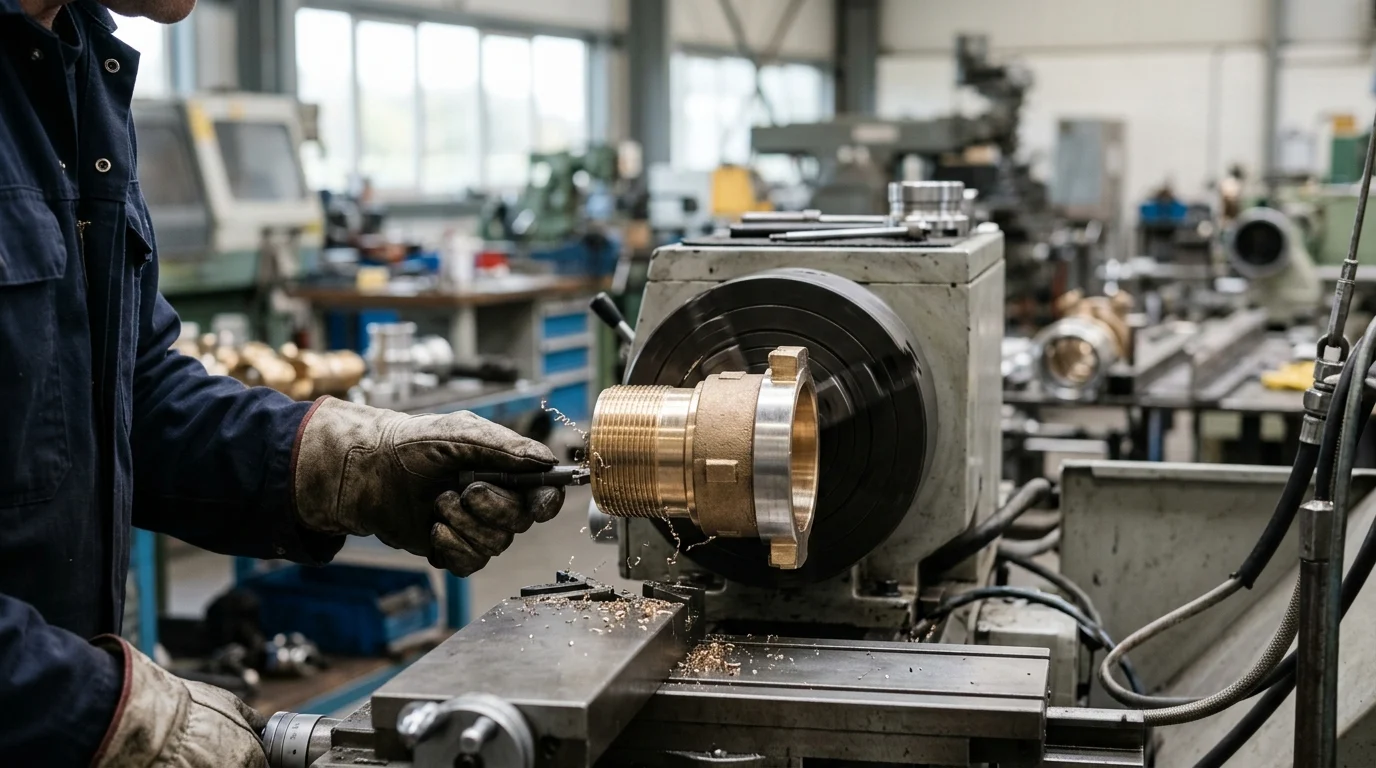
In a fire suppression system, a small imperfection in a coupling, valve, or sprinkler connection can become a high-pressure failure point. Modern fire fittings are expected to seal reliably at operating pressures from 175 psi to well over 300 psi, while preserving predictable water flow during an emergency. That level of dependability increasingly depends on automated finishing—robotic deburring, grinding, polishing, and controlled material removal that standardizes surfaces manual tools often leave inconsistent. This article examines how finishing quality affects hydraulic performance, gasket sealing, corrosion protection, and compliance-driven manufacturing, while showing why programmable automation is becoming essential for safer, faster, and more repeatable fire fitting production.
Why Automated Finishing Matters for Fire Fitting Safety
Fire fitting manufacturing demands rigorous precision, as these components form the critical infrastructure of commercial and industrial fire suppression systems. From grooved couplings and gate valves to sprinkler heads and standpipe connections, fire fittings must perform flawlessly under extreme conditions. Operating pressures typically range from 175 psi in standard commercial systems to over 300 psi in high-rise or specialized industrial applications.
To withstand these pressures without catastrophic failure or leakage, the structural integrity and surface geometry of every fitting must be strictly controlled. Automated finishing has become increasingly essential for modern production. By utilizing programmatic material removal, manufacturers ensure that sealing surfaces, threaded connections, and internal flow paths meet the exact engineering tolerances required for these critical components.
How Surface Finish Affects Fire Fitting Performance
The surface finish of a fire fitting directly impacts its hydraulic efficiency, corrosion resistance, and mechanical sealing capabilities. Rough internal surfaces in cast iron or forged brass fittings create micro-turbulence, which increases the pressure drop across the suppression network. While the Hazen-Williams C-factor applies primarily to straight piping runs, fittings impact hydraulic calculations through minor loss coefficients or equivalent pipe lengths. A highly consistent internal finish minimizes these localized friction losses, ensuring that calculated water delivery rates—often exceeding 1,500 gallons per minute (GPM) in deluge systems—are actually achieved during an emergency.
Furthermore, mating surfaces require exceptional smoothness to prevent gasket extrusion or localized wear. While standard sand casting might yield a Roughness Average (Ra) of 6.3 to 12.5 µm, automated finishing processes refine critical O-ring grooves and sealing faces to an Ra of less than 0.8 µm. This micro-finish prevents microscopic leak paths, eliminates stress concentrators that could lead to fatigue cracking under pressure surges, and ensures uniform adhesion for subsequent protective coatings like epoxy or galvanization.
Key Definitions for Fire Fittings and Automated Finishing
In fire protection infrastructure, "fire fittings" encompass metallic components—such as Storz connections, threaded flanges, mechanical tees, and hydrant valves—used to connect and control the flow of suppressants. They are typically manufactured from ductile iron (e.g., ASTM A536), forged brass, or stainless steel.
In this context, "automated finishing" refers to deploying programmable, mechanized systems for post-casting or post-machining operations like deburring, deflashing, grinding, and polishing. Utilizing CNC (Computer Numerical Control) architecture and robotic articulation, these methodologies align with international manufacturing protocols, such as those established by ISO, to ensure batches adhere to pre-programmed geometric parameters.
Automated Finishing Methods for Fire Fitting Manufacturing
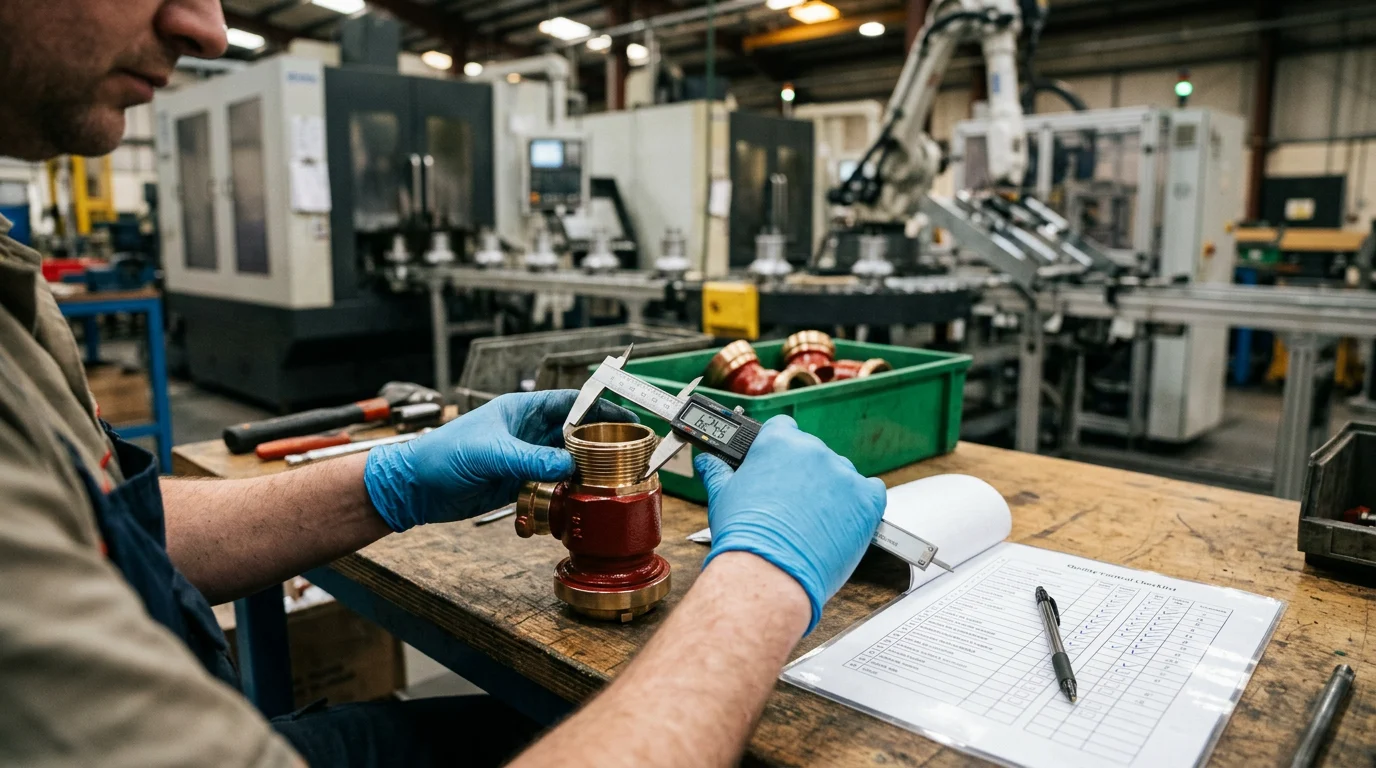
Transitioning to automated finishing introduces a significant advancement in factory floor operations, replacing variable manual labor with programmatic consistency. Manufacturers are increasingly adopting multi-axis robotic cells and advanced mass finishing systems to handle complex geometries, ranging from heavy ductile iron valve bodies to intricate brass sprinkler frames. Illustrative industry estimates suggest this transition can yield a 40% to 60% reduction in cycle times while eliminating the ergonomic hazards associated with hand-held abrasive tools.
Robotic Deburring, Grinding, Polishing, and Blasting
Robotic deburring and grinding represent the forefront of finishing automation. Modern 6-axis robotic arms are equipped with force-compliant end effectors that dynamically adjust the pressure applied to the fitting. This ensures that parting lines and flash from the casting process are removed without altering the component's base geometry. For heavy ductile iron fittings, robotic grinding cells can often remove up to 5 mm of excess flash in a single pass (depending on the specific alloy and tooling) while maintaining dimensional tolerances that can reach ±0.1 mm.
Beyond targeted grinding, mass finishing techniques like automated shot blasting and vibratory polishing are essential for uniform surface preparation. Steel shot blasting, typically operating at 80 to 100 psi, is utilized to achieve an SA 2.5 surface preparation grade (per ISO 8501), stripping away casting scale and providing an optimal anchor profile for powder coating adhesion. For internal passages that are difficult to reach with mechanical tools, abrasive flow machining (AFM) pumps a viscoelastic abrasive medium through the fitting, smoothing internal radii and reducing fluid friction.
Manual vs Automated Finishing Comparison
A comparative analysis highlights contrasts in quality control, labor utilization, and output consistency. Manual finishing relies heavily on operator skill, which can introduce batch-to-batch variability.
| Metric | Manual Finishing (Estimated) | Automated Finishing (Estimated) |
|---|---|---|
| Defect / Rework Rate | 3.0% - 5.0% | < 0.5% |
| Typical Cycle Time (4" Valve) | ~4.5 minutes | ~1.2 minutes |
| Surface Variance (Ra) | ± 1.5 µm | ± 0.2 µm |
| Labor Requirement | High (Skilled operators) | Low (Technicians/programmers) |
| Tool Consumable Waste | High (Uneven wear) | Optimized (Programmed paths) |
As these illustrative estimates demonstrate, automation can significantly lower defect rates. In the high-stakes environment of fire fitting manufacturing, where a single defective thread or compromised gasket seat can result in system failure, this level of statistical process control is highly valued.
Standards and Acceptance Criteria
Fire protection components operate within a heavily regulated sector of the global supply chain. Their physical characteristics and performance limits are dictated by rigorous third-party testing and certification bodies, and automated finishing directly supports a manufacturer's ability to reliably match the approved design prototype.
UL, FM, NFPA, ASTM, ISO, and Regional Requirements
Global and regional markets demand compliance with specific regulatory frameworks. In North America, Underwriters Laboratories (UL) and Factory Mutual (FM) provide the benchmark certifications for fire fittings, alongside installation standards dictated by the National Fire Protection Association (NFPA), such as NFPA 13 for sprinkler systems. Internationally, standards developed by ISO and regional bodies (e.g., LPCB in Europe, VdS in Germany) govern quality management and product specifications.
These organizations require that fittings undergo severe mechanical and hydraulic stress testing. If a fitting's wall thickness is unevenly reduced during finishing, it risks failing the burst pressure tests required by specific UL and FM testing standards. Automated finishing ensures that the structural wall thickness remains exactly as engineered, allowing the fitting to reliably pass certification audits.
Measurable Finish, Cleanliness, and Defect Criteria
Acceptance criteria for fire fittings involve highly specific, measurable thresholds. Cleanliness standards dictate that internal waterways must be entirely free of casting sand, machining chips, and loose burrs. A dislodged burr can migrate through a piping network and clog a sprinkler head orifice, which typically measures just 1/2 inch (12.7 mm) in diameter. Consequently, automated deburring programs are validated to ensure a maximum allowable burr height—often specified around 0.05 mm in critical applications—on thread entries and internal intersections.
Defect criteria also mandate rigorous hydrostatic testing. Standard grooved couplings and fittings must routinely withstand hydrostatic pressures—often mandated by test standards to be at least four times their rated working pressure, reaching 700 to 1,200 psi—without exhibiting structural failure, sweating, or permanent deformation. The precision of automated finishing on the gasket housings is a primary factor in passing these zero-leakage hydrostatic tests.
Traceability, Batch Records, and Inspection Data
Modern quality management systems require comprehensive traceability for safety components. Automated finishing equipment integrates seamlessly into factory IoT networks, capturing available real-time telemetry—such as spindle torque, media flow rates, and processing times—for every individual batch. Systems link this data directly to casting heat numbers and stamped lot codes on the fittings.
If a field failure occurs, manufacturers must be able to trace the component back through its entire production lifecycle. Automated cells automatically generate and store inspection data and batch records, often retained for 10 to 15 years depending on regional compliance requirements, to mitigate liability. This digital thread proves that the finishing parameters strictly adhered to the validated process window at the exact moment of manufacture.
Implementation Planning for Manufacturers
Integrating automated finishing into an existing fire fitting production line requires strategic capital expenditure planning and rigorous process engineering. Successful implementation relies on a phased approach, moving from theoretical process mapping to validated pilot runs before scaling to full production.
Process Mapping, Part Families, and Pilot Runs
The first step in implementation is process mapping, which involves categorizing the manufacturer's catalog into distinct part families based on geometry, material, and required finish. For example, 90-degree elbows, straight tees, and concentric reducers of similar diameters can share the same robotic end effectors and gripping fixtures. By grouping parts, engineers minimize the need for frequent, time-consuming tool changes.
Once part families are established, manufacturers conduct pilot runs. A pilot run typically involves processing a statistically significant sample size—often ranging from 300 to 500 units—through the automated cell. Quality engineers measure the output against the baseline Ra values and dimensional tolerances to fine-tune robot trajectories, abrasive speeds, and cycle times before authorizing full-scale continuous production.
Integration Trade-Offs Across Cost, Quality, and Throughput
While automation offers significant advantages, it is not without limitations. Robotic cells require specialized programming expertise, ongoing maintenance, and time-consuming fixture changeovers, which can result in poor ROI for high-mix, low-volume production environments. Selecting the appropriate technology requires balancing these operational realities alongside estimated capital expenditure (CAPEX), throughput, and quality requirements. Beyond initial CAPEX, total cost of ownership (TCO) calculations must account for ongoing operating expenses, including abrasive media consumption, spindle and end-effector wear, and specialized programming labor.
| Technology / Method | Illustrative CAPEX (USD) | Optimal Volume (Units/Yr) | Primary Fire Fitting Application |
|---|---|---|---|
| Vibratory Bowl Finishing | $20,000 - $60,000 | 10,000 - 50,000 | Bulk deburring of small brass sprinkler frames and threaded adapters |
| 6-Axis Robotic Grinding Cell | $150,000 - $350,000 | 50,000+ | Precision flash removal on heavy ductile iron valve bodies and large couplings |
| Abrasive Flow Machining (AFM) | $80,000 - $250,000 | 25,000+ | Internal passage smoothing for complex deluge and pre-action valves |
| Automated Shot Blasting | $50,000 - $150,000 | 50,000+ | Surface prep and stress relief prior to red epoxy/powder coating |
An advanced 6-axis robotic cell requires a significant initial investment, but it offers high throughput and precision for heavy iron components. Conversely, vibratory finishing offers a lower barrier to entry for manufacturers producing high volumes of smaller, less complex brass fittings.
Logistics, Sourcing, and Supplier Qualification
Implementing automation also impacts upstream supply chain logistics and supplier qualification. Automated finishing cells operate most efficiently with highly consistent raw inputs. They can be sensitive to upstream variability; if a foundry supplies raw castings with excessive dimensional variation or unpredictable flash thickness, the robotic cell may fault or fail to clean the part adequately.
Therefore, manufacturers must enforce stricter tolerances on their casting and forging suppliers. Minimum Order Quantities (MOQs) also shift; automated systems favor larger, uninterrupted production runs to maximize ROI, often pushing optimal batch sizes into the thousands. Sourcing managers must align these larger batch requirements with inventory carrying costs and raw material procurement schedules for alloys like C36000 free-machining brass or ASTM A536 ductile iron.
Decision Framework for Buyers and Manufacturers
Procurement managers, operations directors, and system buyers must navigate a complex decision matrix when sourcing or manufacturing fire fittings. The choice between investing in proprietary automated finishing capabilities or leveraging specialized contract manufacturers hinges on total cost of ownership (TCO), production volumes, and core competencies.
In-House Automation vs Outsourced Finishing
The decision to automate in-house versus outsourcing to a contract finishing facility is driven primarily by annual production volumes and part complexity. For specialized fire fittings with low annual volumes (e.g., fewer than 10,000 units per year), the depreciation and maintenance costs of dedicated in-house equipment—even entry-level vibratory systems—are difficult to justify. In these scenarios, outsourcing to a specialized finishing house—typically at estimated variable costs ranging from $0.50 to $2.50 per part depending on size—preserves capital and maintains quality.
However, for high-volume manufacturers producing upwards of 50,000 to 100,000 units of standardized couplings or sprinkler heads annually, in-house automation becomes a strategic imperative. Bringing the process in-house tightens the feedback loop between casting, machining, and finishing, reducing work-in-progress (WIP) inventory and protecting proprietary tooling designs from third-party exposure.
How Automated Finishing Supports Safer Fire Protection Systems
Ultimately, automated finishing transcends basic manufacturing efficiency by minimizing
Key Takeaways
- Prioritize automated finishing on sealing faces, threaded connections, O-ring grooves, and internal flow paths because these areas directly influence leakage control and hydraulic performance.
- Specify surface roughness targets for critical fire fitting interfaces, such as reducing sealing surfaces from typical cast Ra 6.3–12.5 µm to below Ra 0.8 µm where required.
- Use robotic deburring, grinding, and polishing to reduce manual variation and maintain repeatable geometry across ductile iron, forged brass, and stainless steel fittings.
- Evaluate automation where systems must support operating pressures from 175 psi to more than 300 psi, since inconsistent finishing can increase leakage and fatigue risks.
- Consider automated finishing cells when production requires faster throughput, as industry estimates indicate potential cycle-time reductions of 40% to 60% versus manual abrasive work.
Frequently Asked Questions
Why does surface finish matter in fire fitting manufacturing?
Surface finish affects sealing, corrosion resistance, hydraulic flow, and fatigue life. Smoother internal paths reduce localized friction losses, while refined gasket faces and O-ring grooves help prevent leaks under high operating pressure.
What pressures must fire fittings typically withstand?
Many commercial fire suppression systems operate around 175 psi, while high-rise or specialized industrial systems may exceed 300 psi. Finishing quality must support leak-free performance under these demanding conditions.
Which fire fitting areas benefit most from automated finishing?
Critical areas include sealing faces, threaded connections, O-ring grooves, internal flow paths, casting parting lines, and valve body surfaces. These zones directly affect leak prevention, assembly quality, and hydraulic performance.
How does robotic finishing improve consistency?
Robotic grinding, polishing, and deburring use programmed motion and controlled material removal, reducing operator variation. This helps manufacturers maintain repeatable geometry and surface quality across production batches.
What surface roughness can automated finishing achieve?
While sand-cast surfaces may measure about Ra 6.3 to 12.5 µm, automated finishing can refine critical sealing surfaces to below Ra 0.8 µm, depending on material, tooling, and process design.