


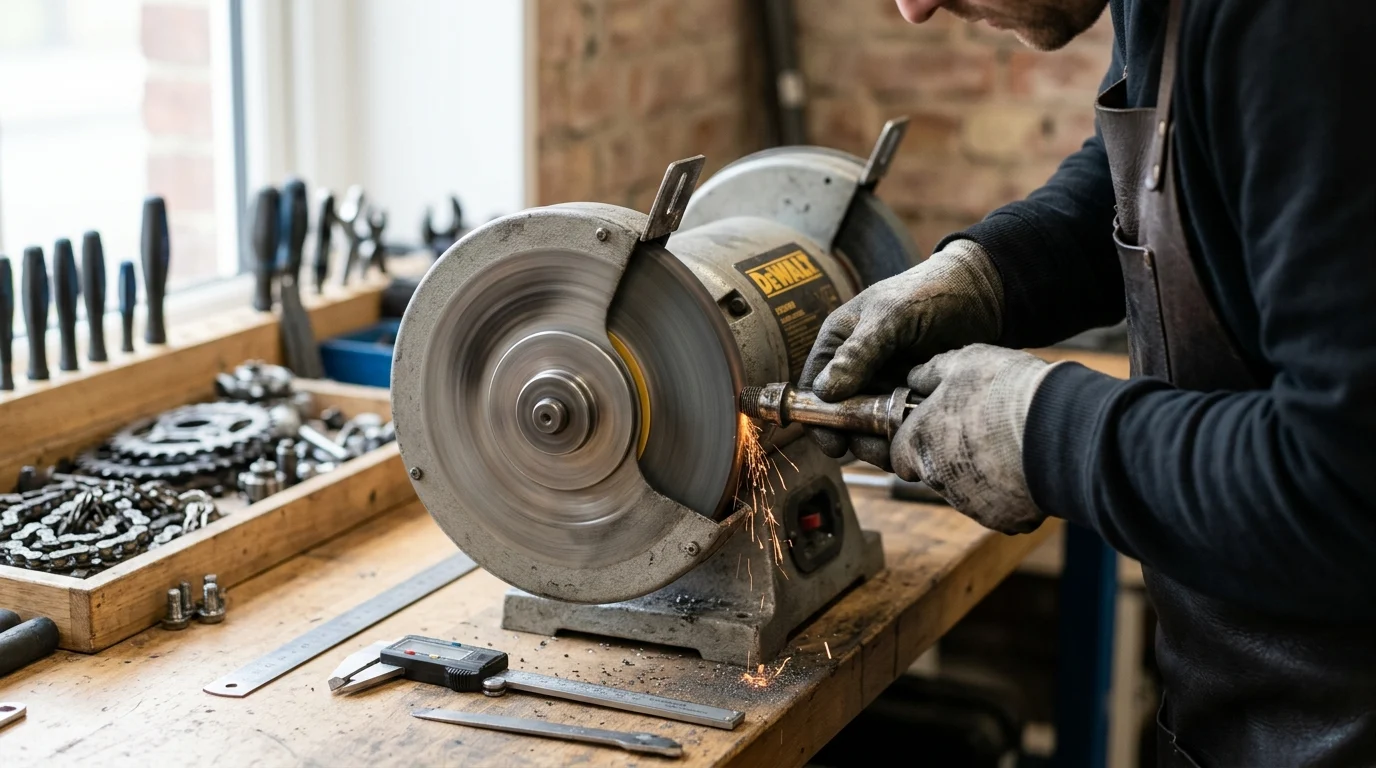
Global bicycle manufacturing is no longer defined by simple frames and basic drivetrain parts; it now serves high-performance road bikes, rugged mountain platforms, and torque-heavy e-bikes competing in tightly regulated export channels. In this environment, grinding has become a strategic quality process, not just a finishing step. The right approach can deliver micron-level dimensional control, smoother bearing interfaces, and more reliable performance under repeated mechanical stress. Yet precision grinding is not always the most economical choice, especially for commodity parts. This article explains where bicycle component grinding creates measurable value, how it supports international buyer and safety requirements, and how manufacturers can balance cost, tolerance, and export readiness.
How Bicycle Parts Grinding Supports Global Export Requirements
Bicycle parts grinding represents a critical manufacturing phase that bridges the gap between raw machining and the precise tolerances required by modern cycling applications. As the global bicycle industry shifts toward high-performance components, electric bikes (e-bikes), and professional-grade drivetrains, the standard for surface finish and dimensional accuracy has risen dramatically. While precision grinding is essential for premium and safety-critical components, it is not always economically justified for all commodity bicycle parts, where alternative finishing methods like hard turning (typically achieving Ra 0.8–1.6 µm) or vibratory finishing may offer a better cost-benefit trade-off. For manufacturers engaged in international trade, mastering this process is essential. Global export markets enforce strict acceptance criteria, meaning that slight deviations can lead to costly import rejections. Understanding how grinding technologies align with these requirements allows OEMs to optimize their supply chains and deliver reliable components that perform flawlessly under extreme mechanical stress.
Definition and scope of bicycle parts grinding
The scope of bicycle parts grinding encompasses the precise removal of material (typically ranging from 0.01 mm to 0.15 mm per pass) from metallic components using abrasive wheels to achieve tight geometric tolerances and superior surface finishes that conventional machining cannot match. While many standard bicycle parts achieve sufficient quality through turning or milling, precision grinding is deployed to address the unique constraints of modern cycling. For instance, weight minimization often requires thin-walled tubing and heavily pocketed structures, which are susceptible to distortion under heavy cutting forces; grinding provides the low-pressure material removal necessary to maintain structural integrity.
In the bicycle industry, grinding is often applied to hardened steel, titanium, and aerospace-grade aluminum alloys. The process routinely achieves surface roughness (Ra) values as low as 0.2 µm, which is vital for reducing friction in moving assemblies. The scope extends across various techniques, including centerless, cylindrical, and surface grinding, each tailored to specific component geometries ranging from simple cylindrical axles to complex asymmetric suspension parts. It is worth noting that while grinding achieves exceptional precision, it is not always the final machining step. For the highest-tier bicycle drivetrain components, subsequent honing, lapping, or superfinishing is often required to achieve ultimate bearing performance and longevity.
Export market demands for precision-ground components
Export markets exhibit stringent demands for precision-ground components, driven primarily by the need for interoperability, durability, and compliance with international safety frameworks such as ISO standards (e.g., ISO 4210 for bicycle safety). However, many of the tightest tolerances are buyer-driven OEM specifications rather than universal regulatory mandates. Depending on the contract, European and North American importers may expect defect rates to remain exceptionally low—sometimes targeting benchmarks like 50 parts per million (PPM) for premium parts—a threshold achieved through highly controlled grinding operations.
The rise of e-bikes has further amplified these demands. Electric drivetrains subject systems to sustained motor output torque frequently exceeding 85 Nm. While actual loads on individual ground components vary, OEM specifications require parts to possess flawless surface integrity to prevent fatigue cracking under amplified stress. Furthermore, export buyers demand consistency across production batches of hundreds of thousands of units (with typical Minimum Order Quantities [MOQs] ranging from 10,000 to 50,000 pieces), ensuring that a bottom bracket spindle manufactured in January matches the exact specifications of one produced in November.
Key bicycle components affected by grinding quality
Several key bicycle components are highly sensitive to grinding quality, with drivetrain and suspension systems being the most critical. Bottom bracket spindles and wheel hub axles require centerless grinding to ensure perfect cylindricity, allowing bearings to seat properly without inducing premature wear. A deviation of even 2 to 5 microns in these areas can result in audible clicking, increased rolling resistance, and eventual bearing failure.
Suspension stanchions represent another critical application. The outer diameter of a suspension fork tube must be precision-ground before anodizing or coating to ensure a perfect seal with the fork lowers. If the grinding process leaves microscopic chatter marks or fails to achieve the required Ra value, hydraulic fluid will leak past the seals during compression. Similarly, bearing races and freehub pawl engagements rely on ground surfaces to handle high-RPM friction and rapid mechanical engagement without seizing.
Critical Grinding Specifications for Export-Quality Bicycle Parts
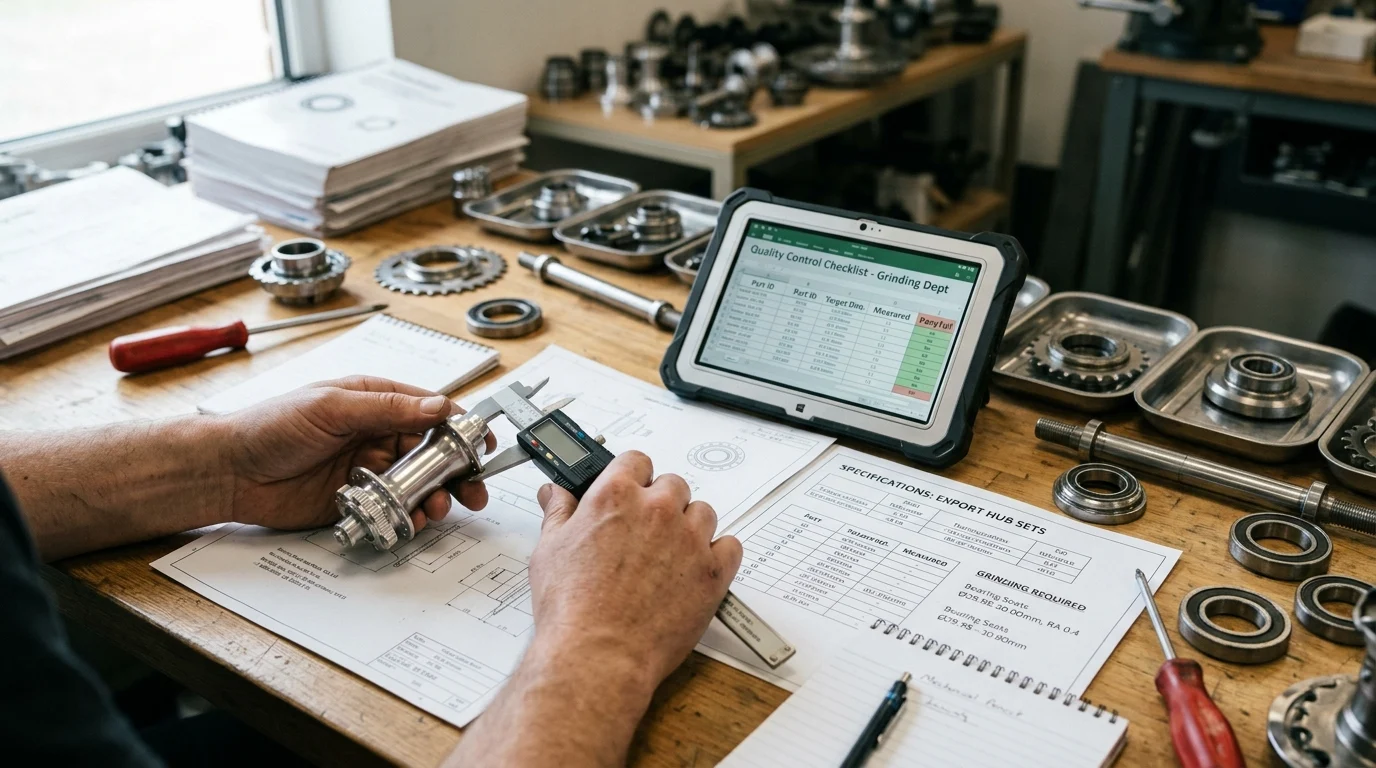
Achieving export-quality bicycle components requires strict adherence to advanced grinding specifications. The transition from a functional part to a high-performance export commodity is defined by the mathematical precision of its geometry. Importers closely evaluate these metrics, often utilizing coordinate measuring machines (CMM) and optical comparators during inbound quality control. Understanding and controlling these specifications is the bedrock of successful international distribution.
Tolerance, roundness, flatness, and concentricity
Dimensional tolerance, roundness, flatness, and concentricity serve as the foundational metrics for ground bicycle parts. Depending on the tier of the component, buyer-driven dimensional tolerances for bearing journals on hub axles can be extremely tight. For example, a target specification might require adherence to a window as narrow as ±0.002 mm. If an axle is oversized, the bearing will not press-fit correctly; if undersized, the bearing will slip, risking hub failure under load.
Roundness and concentricity are equally critical, particularly for rotating masses. For premium applications, a buyer might specify the roundness of a bottom bracket spindle to not exceed a maximum deviation of 0.0015 mm. Concentricity ensures that the rotational axis of the part aligns perfectly with its physical center. For brake rotors, flatness is the primary specification; surface grinding is often tasked with maintaining flatness within a standard of 0.05 mm across the entire braking track to prevent pulsing and ensure consistent hydraulic pad engagement.
Material-specific grinding variables for aluminum and steel
Material composition dictates the specific grinding variables required to achieve these tolerances. Aluminum alloys, commonly used in lightweight suspension components, are notoriously prone to "loading"—a phenomenon where soft aluminum chips melt and weld to the abrasive wheel. To prevent this, grinding aluminum requires highly porous silicon carbide wheels, specific synthetic water-soluble coolants, and precise surface speeds typically maintained between 30 and 40 meters per second (m/s).
Conversely, grinding hardened steel parts, such as cassette lockrings or bearing races, requires entirely different parameters. Hardened steel demands aluminum oxide or cubic boron nitride (CBN) wheels to effectively cut the hardened matrix without rapid wheel degradation. Wheel speeds for steel applications are often pushed higher, ranging from 45 to 60 m/s, combined with high-pressure oil-based coolants to manage the intense thermal energy generated at the cutting zone and prevent microscopic surface burns.
| Material Category | Typical Abrasive Type | Wheel Speed (m/s) | Coolant Type | Common Bicycle Application |
|---|---|---|---|---|
| Aerospace Aluminum (e.g., 7075-T6) | Porous Silicon Carbide | 30 - 40 | Synthetic water-soluble | Suspension lowers, lightweight linkages |
| Hardened Steel (e.g., 4130 Chromoly) | Aluminum Oxide / CBN | 45 - 60 | High-pressure oil-based | Cassette lockrings, bearing races |
| Titanium Alloys (e.g., Ti-6Al-4V) | Silicon Carbide / Diamond | 15 - 25 | Heavy-duty water-soluble | Premium bottom bracket spindles |
Comparison of common grinding methods
Selecting the appropriate grinding method depends entirely on component geometry and production volume. Centerless grinding is the industry standard for high-volume cylindrical parts without centers, while cylindrical grinding is reserved for complex, multi-stepped shafts. Surface grinding is used exclusively for flat components. It is important to note that the precise tolerances listed below are illustrative, buyer-specific examples rather than universal industry standards.
| Grinding Method | Primary Bicycle Application | Typical High-End Tolerance (mm) | Relative Throughput |
|---|---|---|---|
| Centerless | Hub axles, bottom bracket spindles | ±0.0015 | Very High |
| Cylindrical | Suspension stanchions, complex shafts | ±0.0025 | Medium |
| Surface | Flat brake rotors, spacer rings | ±0.0050 | High |
| Internal (ID) | Bearing race interiors, freehub bodies | ±0.0020 | Low to Medium |
Centerless grinding offers the highest throughput for export volumes, capable of processing thousands of axles per shift. However, cylindrical grinding, while slower, provides the versatility needed for specialized, low-volume professional racing components where multiple diameters must be ground concentric to a single center axis.
Quality Control for Bicycle Parts Grinding
A robust quality control (QC) infrastructure is non-negotiable for bicycle parts grinding. Because grinding is frequently the final machining operation before surface treatment or assembly, any defect that escapes detection results in the scrapping of a high-value, near-finished component. For export markets, where return shipping for defective goods is financially unviable, implementing comprehensive inspection and traceability protocols is the only way to safeguard profit margins and brand reputation.
Inspection steps for export-ready components
Inspection protocols for export-ready components must integrate both in-process and post-process methodologies. In-process inspection often utilizes laser micrometers or air gauges positioned directly on the grinding machine, allowing for real-time dimensional verification (often to a resolution of 0.0001 mm) without breaking the production cycle. This ensures that tool wear is compensated for automatically before tolerances drift out of specification.
Post-process inspection requires a dedicated, climate-controlled quality laboratory. Here, surface profilometers measure the Ra and Rz values of the ground finishes, ensuring they meet the strict friction requirements of the bicycle's drivetrain. Additionally, optical comparators and CMMs are used to verify complex geometries, such as the exact chamfer angles on a ground bearing race, ensuring they match the buyer's CAD data perfectly.
Process capability, traceability, and calibration records
Export buyers carefully review a supplier's Process Capability Index (Cpk), which statistically measures a grinding process's ability to produce parts within specified limits. It is important to note that Cpk targets are contractual benchmarks that vary by buyer and component tier, rather than fixed export thresholds applicable to all bicycle parts. A Cpk of 1.33 is frequently used as an acceptable baseline for standard precision components, indicating that the process variation is well within the tolerance band. For aerospace-grade or professional racing components, buyers may demand a Cpk of 1.67 or higher.
Traceability is equally critical. Every batch of ground components must be accompanied by detailed documentation linking the parts back to specific raw material lots, the exact grinding machine used, and the operator on duty. Calibration records for all measuring instruments must be maintained and regularly audited to ensure that a micrometer reading 15.000 mm in the manufacturing facility reads exactly the same when inspected by the buyer upon import.
Practical workflow from fixture setup to final inspection
A practical grinding workflow begins well before the abrasive wheel contacts the workpiece. The process initiates with meticulous fixture setup; the runout of the workholding device must be dialed in to a specific target, such as 0.002 mm for premium hubs, to prevent eccentric bearing wear and ensure perfect concentricity in the final assembly. Once secured, the grinding wheel must be precisely dressed using a diamond tool to ensure its cutting face is perfectly flat and sharp.
The actual grinding phase must navigate bicycle-specific challenges, such as mitigating distortion risks in thin-walled titanium bottom bracket spindles or preventing chatter on asymmetric frame linkages. Rather than relying on generic roughing and finishing passes, operators must carefully balance feed rates and coolant application specifically to maintain the structural integrity of these lightweight, highly stressed cycling components. Following the grinding cycle, parts immediately enter a demagnetization phase (if magnetic chucks were used) and an ultrasonic cleaning bath (typically operating at 40 kHz for 3–5 minutes) to remove abrasive grit and coolant residue, preparing them for final visual and dimensional inspection.
Compliance, Documentation, and Logistics Considerations
Successfully exporting precision-ground bicycle parts extends beyond manufacturing excellence; it requires mastering the complex web of international compliance, documentation, and logistics. A perfectly ground bottom bracket spindle is useless to an OEM if it arrives corroded, damaged in transit, or impounded by customs due to improper material declarations. Navigating these administrative and physical hurdles is a core competency for any global supplier.
Export documentation and material declarations
Export documentation requires comprehensive material declarations to satisfy international environmental and safety regulations. Importers rely on accurate Harmonized System (HS) codes (such as 8714.
How to Choose a Bicycle Parts Grinding Supplier
Selecting a partner for bicycle parts grinding requires moving beyond basic machining capabilities to evaluate strict tolerances and international compliance. For high-end drivetrains, hubs, or suspension systems, the right supplier ensures compliance with global safety frameworks, such as the ISO 4210 standard for bicycle safety.
Supplier capability, equipment, and inspection standards
Advanced bicycle parts grinding relies on multi-axis CNC grinders and automated centerless grinding systems. Evaluate suppliers based on their ability to consistently achieve surface roughness values below Ra 0.2 microns for critical components like bottom bracket spindles and titanium pedal axles. Furthermore, rigorous inspection protocols are mandatory. A qualified facility must utilize Coordinate Measuring Machines (CMM) and laser micrometers to verify dimensional accuracy, backed by an active ISO 9001 certification to guarantee repeatable quality control.
Cost balance between unit price, scrap reduction, and reliability
Procurement managers must calculate the Total Cost of Ownership (TCO) rather than focusing solely on the initial unit price. Substandard bicycle parts grinding often leads to high scrap rates during final assembly or premature field failures.
- Unit Price: Represents direct machining, tooling, and labor costs.
- Scrap Reduction: High-precision grinding minimizes material waste and rejected batches, ideally keeping defect rates below 50 Parts Per Million (PPM).
- Reliability: Consistent tolerances prevent assembly line halts, reduce warranty claims, and avoid costly international product recalls.
Decision criteria for long-term export manufacturing
For global export markets, long-term supplier viability depends on scalability, material traceability, and logistical integration. Suppliers must provide full metallurgical certifications to prove raw material integrity and demonstrate capacity flexibility to handle the seasonal demand spikes typical in the cycling industry.
| Evaluation Criterion | Minimum Export Requirement | Ideal Standard for Premium Parts |
|---|---|---|
| Dimensional Tolerance | ± 0.01 mm | ± 0.002 mm |
| Quality Certification | ISO 9001 | IATF 16949 or equivalent |
| Inspection Method | Manual micrometers / Gauges | Automated CMM & Optical sorting |
| Traceability | Batch-level tracking | Individual component serialization |
By applying these criteria, original equipment manufacturers (OEMs) can secure a grinding partner capable of sustaining high-volume, defect-free production that meets the rigorous demands of international trade.
Key Takeaways
- Use precision grinding for bicycle components that require tight geometry, low friction, or high fatigue resistance, especially axles, bearing seats, drivetrain parts, and e-bike assemblies.
- Evaluate cost-benefit carefully because hard turning can achieve Ra 0.8–1.6 µm and may be more economical than grinding for non-critical commodity parts.
- Specify grinding allowances and process parameters early, since material removal typically ranges from 0.01 mm to 0.15 mm per pass.
- Target surface finishes as low as Ra 0.2 µm for premium moving assemblies where friction reduction, fit, and durability directly affect product performance.
- Align grinding quality controls with buyer-driven OEM requirements and international frameworks such as ISO 4210 to reduce the risk of export rejection.
- Account for e-bike load demands, as sustained motor torque above 85 Nm can make precision-ground drivetrain and bearing interfaces more important.
Frequently Asked Questions
Why is grinding important for exported bicycle parts?
Grinding helps achieve tight tolerances, low surface roughness, and consistent geometry, which are critical for export acceptance, OEM specifications, and safety-related performance in components such as axles, bearings, drivetrain parts, and e-bike assemblies.
What surface finish can bicycle parts grinding achieve?
Precision grinding can routinely achieve surface roughness values around Ra 0.2 µm, depending on material, machine setup, abrasive selection, and process control. This helps reduce friction and improve durability in moving assemblies.
Is precision grinding necessary for every bicycle component?
No. Commodity parts may be better served by hard turning, milling, or vibratory finishing when tolerances and surface finish requirements are less demanding. Grinding is most valuable for premium, hardened, thin-walled, or safety-critical components.
Which bicycle parts commonly require grinding?
Common applications include axles, bearing seats, suspension components, drivetrain parts, brake interfaces, and other precision metal parts made from hardened steel, titanium, or aerospace-grade aluminum alloys.
How do e-bikes increase grinding requirements?
E-bike drivetrains can experience sustained torque above 85 Nm, placing higher loads on gears, shafts, and bearing interfaces. Precision grinding improves fit, surface integrity, and fatigue resistance under these demanding conditions.