


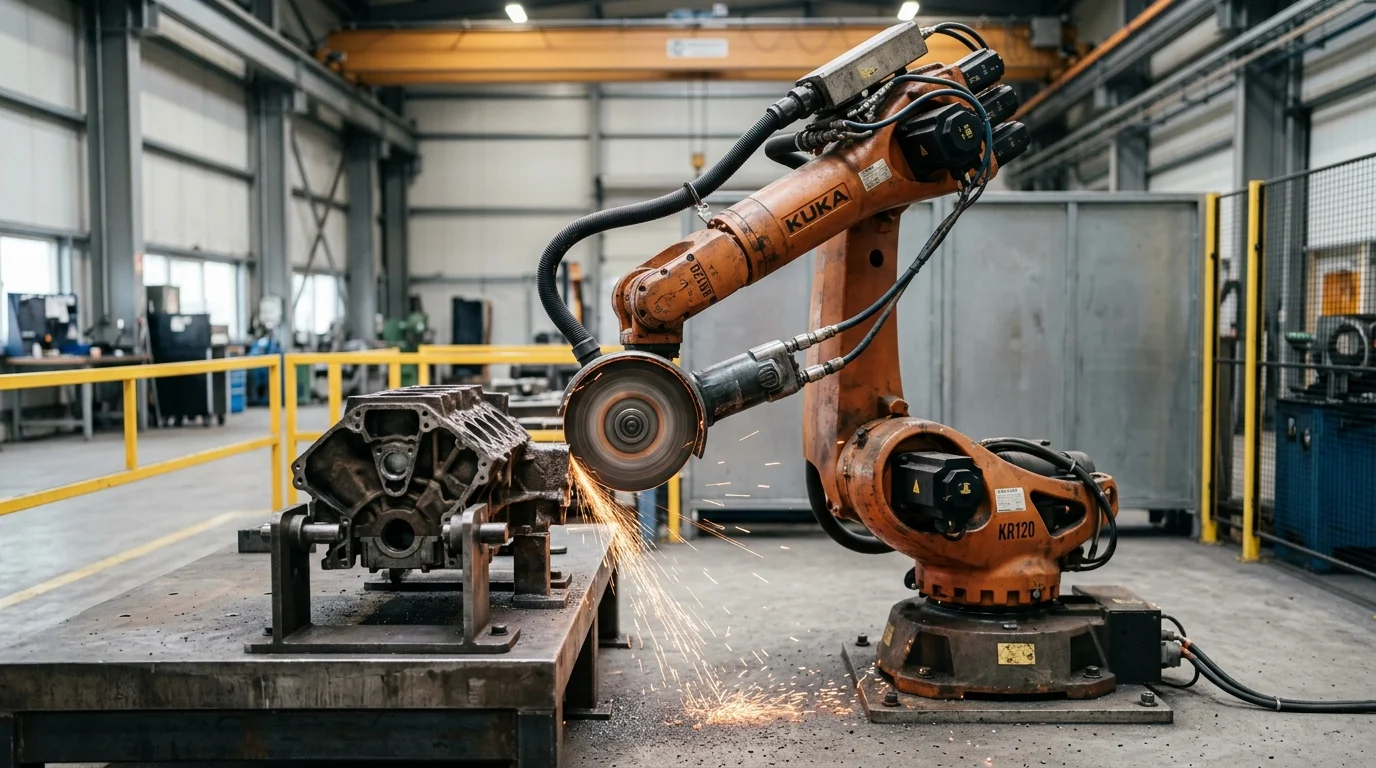
Foundry finishing is under pressure from two directions: demand for stable output is rising, while experienced grinding labor is getting harder to retain. Manual fettling remains one of the most physically demanding jobs in casting production, with constant vibration, abrasive dust, and repetitive strain affecting both safety and throughput. Robotic grinding is becoming a practical response, especially for repeatable castings where flash, gates, and risers must be removed shift after shift. This article explains where automated grinding delivers the strongest return, which parts and alloys are best suited, what equipment a reliable cell requires, and where automation still has limits.
Why Foundries Adopt Robot Grinding
Post-casting finishing has historically relied on intensive manual labor to remove excess material and achieve final dimensional tolerances. Today, the transition toward Industry 4.0 is prompting a shift in how foundries approach post-processing. Rather than viewing fettling—the removal of excess material from raw castings—as an unavoidable manual bottleneck, facilities are increasingly integrating 6-axis industrial robots to automate material removal. This technological evolution aims to modernize operations, stabilize production schedules, and improve overall process control on the foundry floor.
Labor, safety, and throughput pressures
The primary catalyst for this automation is the severe contraction of the industrial labor pool, a demographic shift noted in global manufacturing analyses by institutions like the World Bank. Manual grinding operators frequently endure high-frequency vibration, airborne particulate exposure, and repetitive strain injuries. These harsh conditions drive high annual turnover rates that frequently disrupt finishing departments. Beyond labor retention, throughput pressures dictate a shift; robotic grinding cells can operate continuously across multiple shifts, substantially increasing throughput compared to manual stations. By removing workers from the physically demanding environment of the finishing shop, foundries mitigate business risks associated with labor shortages while securing a stable, scalable production capacity.
Suitable casting types, alloys, and finishing tasks
Not all castings are immediate candidates for robotic finishing, but the technology excels with medium-to-high volume production runs of ductile iron, carbon steel, and aluminum components. Optimal applications involve removing parting line flash, gate stubs, and riser remnants on castings weighing between 10 kg and 250 kg. Heavy commercial vehicle hubs, pump housings, and engine blocks represent prime candidates. Modern active force compliance technologies—which allow robots to dynamically adjust tool pressure—enable these systems to adapt to the inherent dimensional variations of sand-cast alloys, ensuring uniform material removal even when parting line flash thickness varies by up to 3.0 mm in localized areas. However, robotic grinding cannot compensate for fundamentally unstable sand-cast processes; upstream molding must remain reasonably controlled.
Conversely, robotic grinding is generally unsuitable for one-off custom castings, high-mix low-volume production environments, or parts with complex internal geometries where robot articulation is physically restricted. In these scenarios, the programming overhead and fixturing costs often outweigh the automation benefits.
What Makes an Effective Robot Grinding Cell
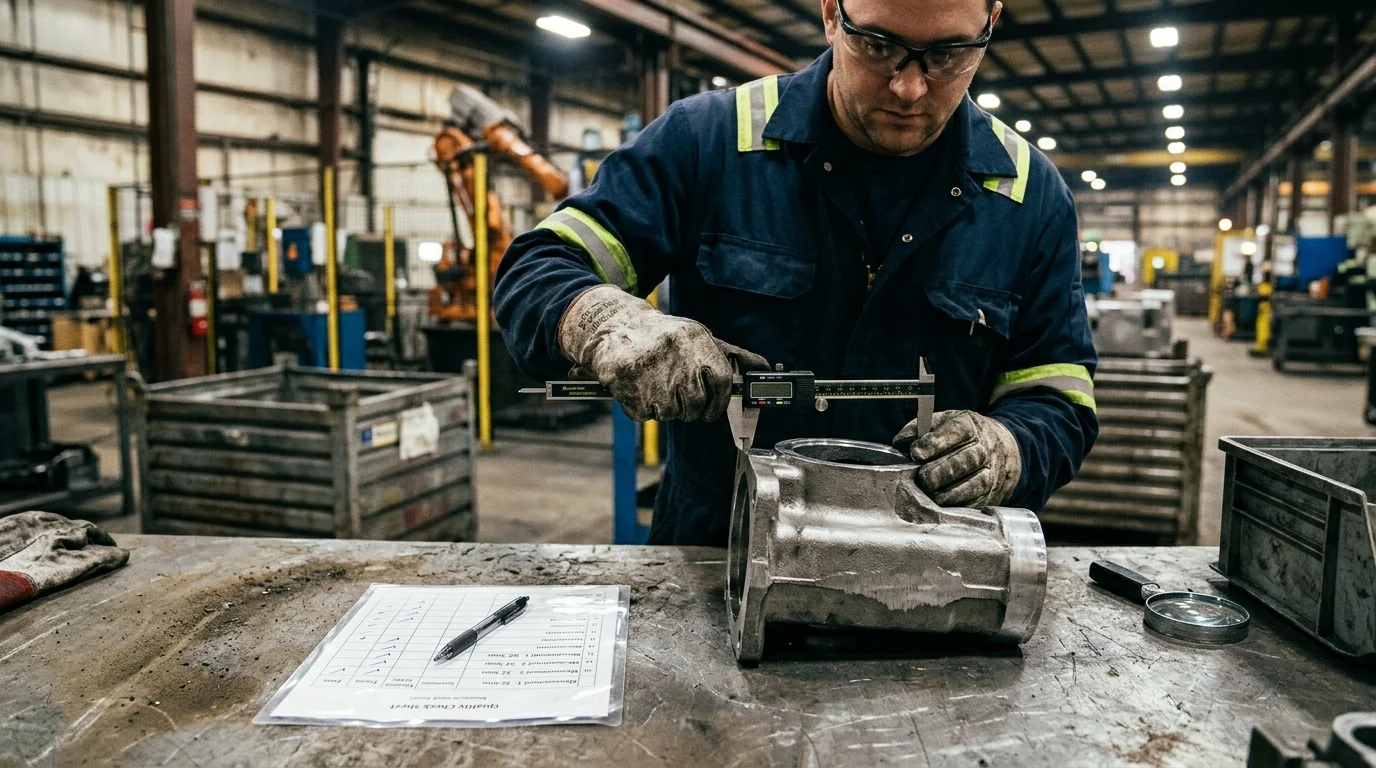
Designing a robust robotic finishing system requires integrating specialized hardware capable of withstanding aggressive vibrations and highly abrasive airborne dust. A successful cell combines heavy-duty components, high-torque spindles, and adaptive control algorithms to replicate, and ultimately exceed, the process consistency and material removal outcomes of a skilled human operator.
Robots, spindles, abrasives, and fixtures
The core of the cell is typically a high-payload articulated robot, often rated for heavy capacities (e.g., 150 kg to 300 kg) to ensure sufficient structural rigidity against substantial contact forces. End-of-arm tooling (EOAT) features heavy-duty spindles operating at speeds ranging from 5,000 to 24,000 RPM, depending on the required abrasive media and surface finish. Foundries increasingly favor diamond-electroplated wheels or advanced ceramic belts, which manufacturers claim can offer significantly longer lifespans than standard aluminum oxide abrasives, depending on the baseline abrasive, alloy type, and operating conditions. Workholding must be exceptionally rigid, frequently utilizing hydraulic or pneumatic clamping mechanisms capable of securing complex geometries against intense grinding forces.
Manual grinding vs CNC grinding vs robotic grinding
Selecting the appropriate finishing method depends on the required tolerances, capital budget, and batch sizes. While manual grinding offers maximum flexibility for low-volume, highly variable castings, it suffers from inconsistent quality and high labor costs. CNC machining centers provide extreme precision and can achieve complex kinematic reach, but robotic grinding offers lower capital cost and greater flexibility for heavy, irregular sand castings where dedicated CNC fixturing is impractical. Ultimately, robotic grinding occupies a practical middle ground, offering the articulation to process complex shapes and the adaptive force control to handle casting variations. However, it is important to note that robotic grinding can sometimes yield longer per-part cycle times than manual grinding on highly complex geometries, which is a critical planning caveat for ROI and throughput calculations.
| Feature | Manual Grinding | Robotic Grinding | CNC Machining |
|---|---|---|---|
| Tolerance Capability | Low (varies by geometry/alloy) | Medium (illustrative ± 0.5 mm to 1.0 mm) | High (illustrative ± 0.01 mm) |
| Capital Expenditure | Low | Medium | High |
| Setup Flexibility | High | Medium | Low |
| Cycle Time Consistency | Low | High | High |
| Ideal Batch Size | Small (highly variable) | Medium to Large (typically 50+) | Variable |
Quality and Safety Benefits
The implementation of robotic grinding fundamentally transforms the foundry finishing department from a hazardous, highly variable operation into a controlled, predictable manufacturing process. This dual impact on part quality and operator safety forms the core technical justification for heavy automation investments.
Consistency, repeatability, and defect reduction
Manual fettling inherently suffers from fatigue-induced variation over the course of a shift, resulting in over-grinding (gouging the base metal) or under-grinding (leaving unacceptable flash). By utilizing the active force compliance discussed earlier, robotic systems maintain consistent applied pressure regardless of tool wear or slight geometric deviations in the raw casting. This precise control ensures dimensional repeatability across thousands of cycles. Consequently, foundries frequently report significant reductions in grinding-related scrap rates, vastly improving overall yield and downstream machining efficiency compared to historical manual averages.
Dust extraction, guarding, noise, and abrasive safety
Fully enclosed robotic cells integrate high-velocity downdraft tables and wet dust extraction systems capable of capturing massive volumes of respirable crystalline silica and combustible metallic dust. Acoustic enclosures effectively reduce ambient noise levels from dangerous highs at the point of contact to below the 85 dB action level commonly mandated by regulatory exposure limits (e.g., OSHA) and guided by technical acoustics standards like ISO 1999 outside the cell. Furthermore, automated guarding and the elimination of direct manual interaction with high-speed abrasives eradicate the risk of severe lacerations or blunt trauma caused by shattered grinding wheels.
How to Implement Robot Grinding
Deploying a robotic grinding cell is an engineering-intensive endeavor that extends far beyond simply purchasing a robotic arm. Success hinges on a systematic approach to application selection, programming methodology, and workholding design tailored to the harsh realities of the foundry floor.
Part selection and process planning
Foundries must begin with strategic part selection, often applying the Pareto principle to identify the 20% of part families that consume 80% of manual grinding labor. Ideal initial candidates possess stable gating designs and consistent parting lines. Process planning heavily relies on Offline Programming (OLP) software, which allows manufacturing engineers to import CAD models of the castings and generate complex toolpaths in a virtual environment. This approach minimizes physical downtime during cell commissioning and allows for rigorous collision detection before the robot engages a grinding wheel on the production floor. However, facilities must acknowledge the hidden engineering burden: OLP requires significant physical teach-point refinement to account for sand-cast variation. Initial commissioning often involves higher scrap rates and cycle-time instability before grinding paths are fully optimized. Beyond initial setup, facilities must add a clear caveat to their planning: automation does not simply eliminate skilled labor; rather, it shifts the requirement from manual grinding to technical roles. Operations demand ongoing expertise, including skilled robot programmers, vision technicians, and routine force-sensor calibration to maintain optimal performance.
Managing fixturing variation and integration risks
The greatest integration risk in foundry automation is geometric variation. Castings exhibit core shifts, variable shrinkage depending on the alloy, and inconsistent gate breakouts. To manage this, integrators utilize a combination of compliant tooling and 3D machine vision. Vision systems can scan the incoming raw casting, identify the exact location and volume of the flash, and dynamically offset the robot's coordinate system. However, these 3D machine vision systems—particularly structured light and laser triangulation sensors—are vulnerable in foundry environments. Their optics require regular cleaning, protection from abrasive dust, and recalibration; if not aggressively maintained, dirty or overheated sensors can cause misalignment and severe tool crashes. When paired with modular fixturing that utilizes self-centering hydraulic jaws, foundries can reliably secure irregular castings and adapt the grinding path in real-time, mitigating the risk of tool crashes and incomplete finishing.
When Robot Grinding Delivers ROI
The capital expenditure for robotic finishing technology is substantial, necessitating a comprehensive financial analysis. However, when deployed on appropriate product lines with sufficient volume, the return on investment (ROI) can be highly predictable. It is important to note that achieving these financial targets depends heavily on maintaining high utilization rates and consistent part geometries.
Key cost drivers and payback factors
A fully integrated robotic grinding cell requires a significant initial investment, heavily dependent on the payload capacity, spindle complexity, and vision system requirements. The primary ROI drivers are direct labor savings (often eliminating multiple shifts of manual operators), increased throughput, and a dramatic reduction in consumable costs. Because robots optimize the contact angle and pressure applied to the abrasive media, foundries operating under optimal conditions consistently document reductions of 20% to 40% in annual abrasive spending. However, facilities must also account for end-effector and spindle consumable costs, which are often higher than manual tooling due to aggressive foundry conditions. When factoring in the reduction of scrapped parts and a decrease in workers' compensation claims, the projected payback period for a high-utilization cell typically ranges from 18 to 36 months. Facilities must also account for ongoing operating costs—such as annual maintenance, energy consumption, and spare-part inventory for harsh foundry environments—which can materially extend this timeframe.
Retrofitting vs investing in a new cell
Facility managers must weigh the financial merits of retrofitting existing manual booths with robotic arms versus procuring entirely new, pre-engineered turnkey cells. Retrofitting can lower the initial capital outlay but introduces significant integration risks regarding dust collection compatibility and safety guarding compliance. Conversely, turnkey cells offer guaranteed cycle times and single-source accountability but require more floor space and higher upfront funding.
| Factor | Retrofit Integration | New Turnkey Cell |
|---|---|---|
| Initial Capital Cost | Low to Medium | High |
| Deployment Time | Longer (e.g., 16 to 24 weeks) | Shorter (e.g., 8 to 12 weeks) |
| Floor Space Required | Minimal (Uses existing footprint) | Moderate to High |
| Performance Guarantee | Best-effort | Contractual cycle time/yield |
| System Lifespan | 5 to 7 years | 10 to 15 years |
Further reading:
Key Takeaways
- Prioritize robot grinding for medium-to-high volume castings where repeated removal of flash, gates, and risers creates a consistent automation opportunity.
- Evaluate parts in the 10 kg to 250 kg range first, especially ductile iron, carbon steel, and aluminum castings with accessible external finishing areas.
- Use active force compliance when sand-cast dimensional variation is expected, because it helps maintain consistent tool pressure and material removal.
- Avoid automating one-off, high-mix low-volume, or hard-to-access internal geometries unless the expected labor savings justify programming and fixturing costs.
- Specify heavy-duty robots, spindles, fixtures, and abrasive tooling designed for vibration, dust, and high contact forces in foundry finishing environments.
Frequently Asked Questions
Why are foundries adopting robotic grinding systems?
Foundries are using robotic grinding to reduce dependence on scarce skilled labor, improve worker safety, and stabilize post-casting throughput. Robots can handle repetitive fettling tasks across multiple shifts while reducing exposure to vibration, dust, and ergonomic strain.
Which castings are best suited for robot grinding?
Robot grinding is strongest for medium-to-high volume castings such as vehicle hubs, pump housings, and engine blocks. Typical candidates include ductile iron, carbon steel, and aluminum parts weighing about 10 kg to 250 kg.
What finishing tasks can a robotic grinding cell perform?
A well-designed cell can remove parting line flash, gate stubs, riser remnants, and localized excess material. With active force compliance, robots can adjust pressure as casting dimensions vary, helping maintain consistent material removal.
When is robotic grinding not a good fit?
It is often unsuitable for one-off custom castings, high-mix low-volume production, or parts with complex internal geometries that limit robot access. In these cases, programming and fixturing costs may outweigh productivity gains.
What equipment is needed in an effective robotic grinding cell?
A typical cell includes a high-payload 6-axis robot, heavy-duty spindle, abrasive tools, durable fixtures, dust-resistant components, and adaptive force control. RobotGrindTech solutions focus on integrating these elements for demanding foundry environments.