


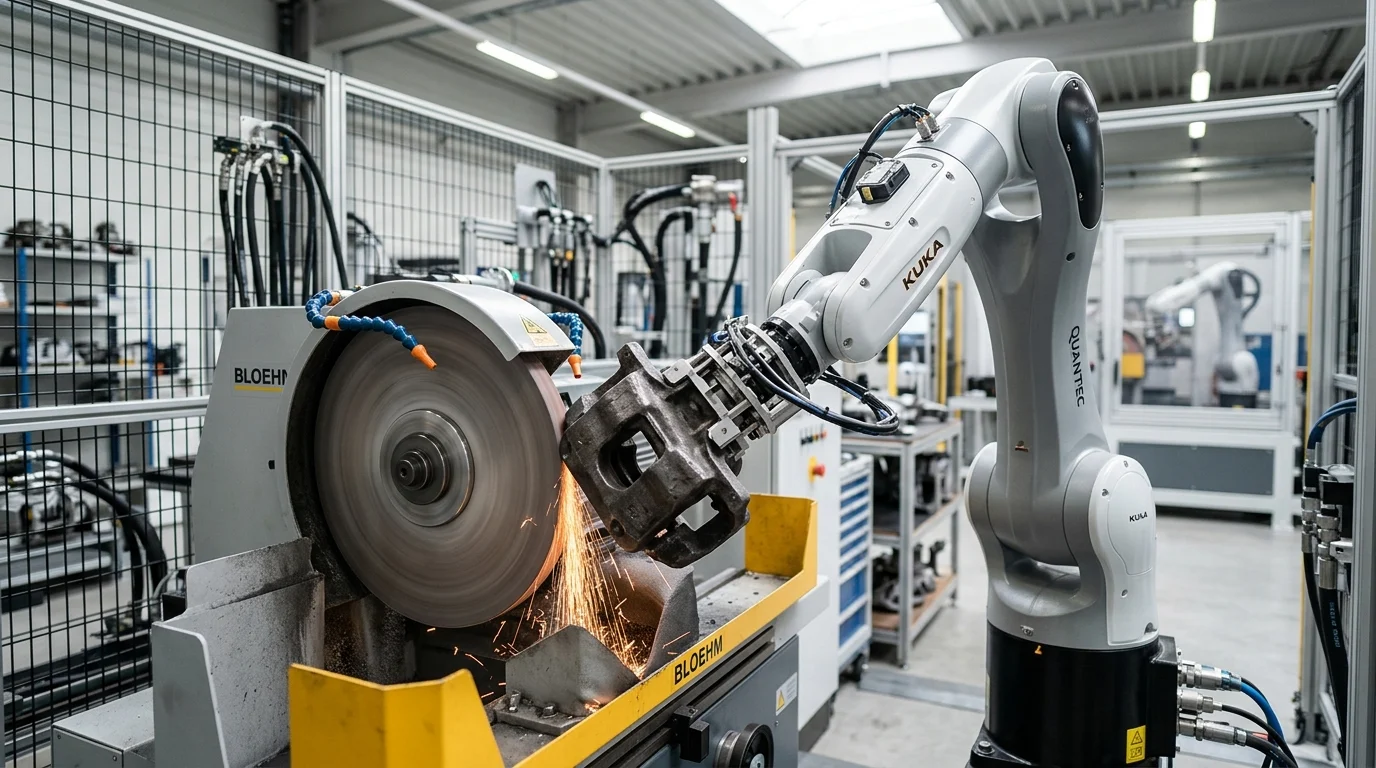
Automotive suppliers are under pressure to make precision finishing faster, quieter, and less dependent on scarce skilled labor. As EV platforms expand, small defects in gears, shafts, housings, and drivetrain components can translate into audible noise, vibration, scrap, or warranty risk. Automated grinding is becoming a practical response: robotic handling, CNC control, in-process measurement, and connected software can turn a traditionally manual operation into a repeatable, data-driven production cell. This article explains why manufacturers are investing now, what technologies define modern grinding automation, and how the right system can improve OEE, reduce scrap, and strengthen quality consistency across high-volume automotive programs.
Why Auto Parts Grinding Automation Is a Strategic Priority
The automotive manufacturing sector is undergoing a profound transformation, driven by the rapid electrification of drivetrains and the relentless pursuit of operational efficiency. Within this shift, auto parts grinding automation has emerged as a cornerstone strategy for Tier 1 and Tier 2 suppliers. Grinding, traditionally a highly skilled and labor-intensive finishing process, is being reimagined through advanced robotics and CNC integration to meet the exacting specifications of modern vehicle architectures.
As internal combustion engines give way to electric motors, the acoustic and mechanical requirements of vehicle components have become significantly more stringent. Automated grinding provides one of the most effective pathways to achieve these tight tolerances consistently at high production volumes, shifting the process from an operator-dependent art to a highly controlled, data-driven science.
Market Pressures Driving Automation
The push toward auto parts grinding automation is heavily accelerated by shifting macroeconomic factors and acute labor shortages. The cost of recruiting and retaining skilled machinists has surged, with wage inflation in precision machining often reaching double digits annually in heavily industrialized regions. As veteran machinists retire, replacing their tacit knowledge of grinding wheel behavior and thermal dynamics is increasingly difficult.
Furthermore, the transition to Electric Vehicles (EVs) introduces new market pressures. EV drivetrains require near-silent operation, mandating tighter geometric tolerances that manual operations cannot reliably sustain at scale. The lack of engine noise means that any gear whine or vibration caused by minute surface imperfections becomes immediately apparent to the consumer, forcing suppliers to upgrade their finishing capabilities to remain competitive.
Commercial Benefits for Automotive Manufacturers
Implementing automated grinding cells yields immediate and measurable operational dividends for automotive manufacturers. The most prominent commercial benefit is the dramatic stabilization of production metrics. Depending on the application, manufacturers often observe Overall Equipment Effectiveness (OEE) climbing from typical baselines of 55%–65% in manual setups to potentially over 85% in fully automated environments.
Scrap reduction is another critical financial driver. In high-value automotive components, where grinding is often the final step after extensive upstream machining and heat treatment, scrapping a part is exceptionally costly. Automation frequently drives scrap rates down from illustrative industry averages of 3%–5% to below 1%. By adhering to stringent quality frameworks, such as the ISO 9001 standard developed by ISO, manufacturers utilizing automation protect their profit margins while significantly mitigating the risk of costly OEM recalls related to surface finish or dimensional defects.
What Auto Parts Grinding Automation Includes
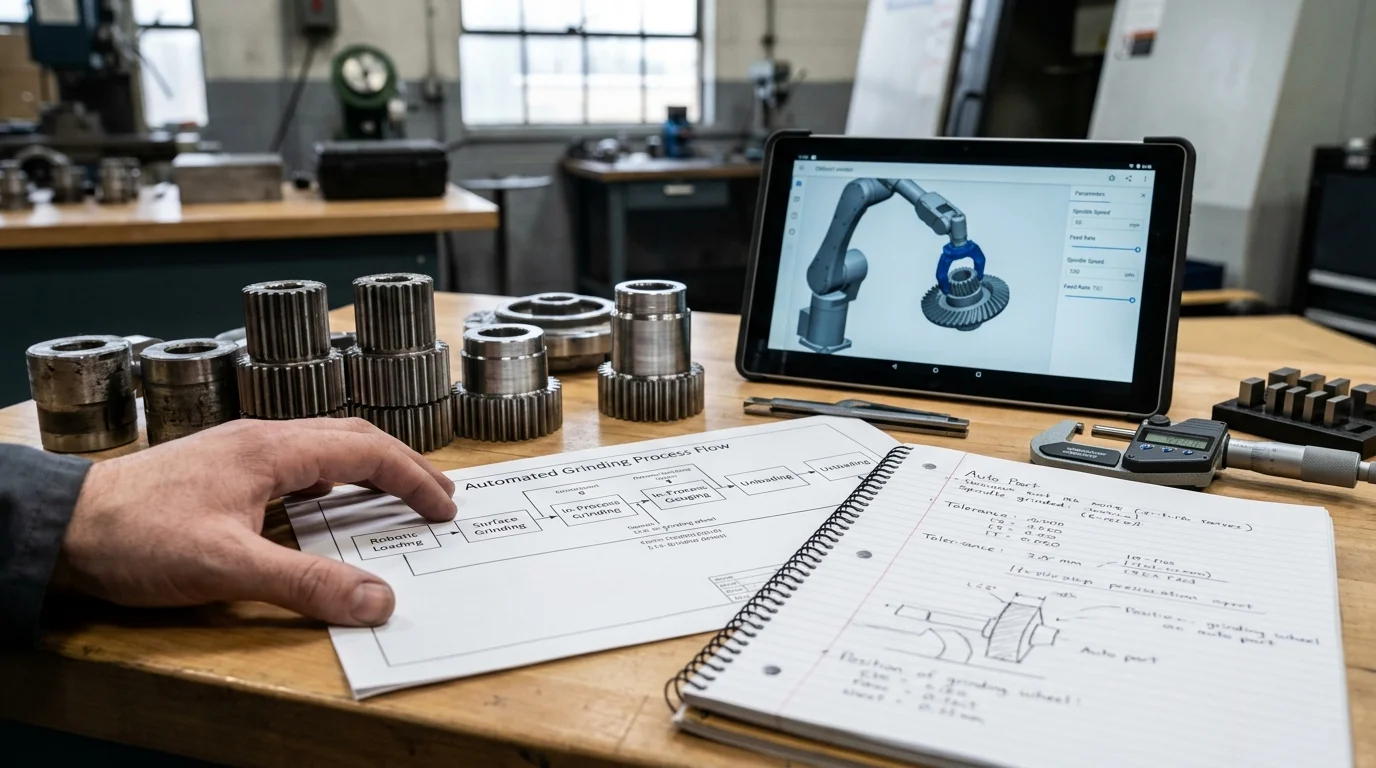
Auto parts grinding automation is not merely the addition of a robot to a legacy machine; it represents a holistic, integrated ecosystem designed for continuous, high-precision material removal. This ecosystem encompasses the grinding machine itself, automated material handling, in-process metrology, and the intelligent software that orchestrates the entire cycle.
To achieve seamless lights-out manufacturing, these systems must integrate seamlessly with factory floor networks, providing real-time data on machine health, wheel wear, and part dimensions. The architecture is designed to minimize human intervention while maximizing spindle uptime.
Key Technologies in Automated Grinding
Modern automated grinding cells rely on multi-axis CNC architectures paired with 6-axis articulated robots or high-speed gantry loaders. A critical technology within this ecosystem is closed-loop feedback metrology. Using tactile probes or optical sensors, the system measures parts in real-time and allows the CNC controller to dynamically auto-compensate for grinding wheel wear, adjusting the final spark-out passes without stopping the cycle.
Automated wheel dressing is another foundational technology. Algorithms determine the optimal interval to run a diamond rotary dresser across the grinding wheel, ensuring the abrasive matrix remains sharp while extending overall wheel life significantly—sometimes by up to 30%, depending on the material. Advanced coolant management systems are also integrated, delivering high-pressure lubrication precisely to the grinding zone to prevent thermal damage to the workpiece, helping to keep thermal expansion variances to a minimum, often below 0.5 micrometers in optimized setups.
Automotive Components Best Suited for Automation
Not all automotive components yield the same return on automation. High-volume, high-precision rotational parts are the prime candidates for automated grinding ecosystems. Complex geometries that require simultaneous interpolation of multiple axes benefit the most from the repeatable precision of CNC and robotic handling. However, it is important to note that manual or semi-automated grinding may still be optimal for prototypes, low volumes, or mixed-model production where the flexibility of human operators outweighs the need for sheer throughput.
Electric vehicle rotor shafts, constant velocity (CV) joint cages, transmission gears, and engine valves are heavily automated due to their strict surface finish and concentricity requirements. The table below outlines the suitability and illustrative specifications for automating the grinding of key automotive components.
| Automotive Component | Typical Grinding Operation | Indicative Target Tolerance (µm) | Automation Suitability |
|---|---|---|---|
| EV Rotor Shafts | OD / Cylindrical Grinding | < 2.0 | Very High |
| Transmission Gears | Profile / Gear Grinding | < 3.0 | High |
| CV Joint Cages | Spherical / ID Grinding | < 5.0 | High |
| Engine Valves | Centerless Grinding | < 4.0 | Very High |
Note: Target tolerances are indicative and vary widely based on specific OEM requirements and component variants.
Manual, Semi-Automatic, and Automated Grinding Compared
Evaluating the transition to auto parts grinding automation requires a clear understanding of how it contrasts with legacy manual and semi-automatic methodologies. The optimal choice for a facility depends heavily on production volumes, part complexity, material, and long-term strategic goals.
While manual grinding relies entirely on human skill for both part handling and process control, automation shifts the burden of precision from the operator to the machine's control architecture, fundamentally altering the cost structure and output potential of the manufacturing floor.
Throughput, Repeatability, and Labor Requirements
Throughput and repeatability vary drastically across the three tiers of grinding methodologies. Manual grinding is inherently limited by operator fatigue and handling times, typically yielding unpredictable cycle times and limiting overall throughput. Repeatability fluctuates wildly depending on the specific operator's experience and technique.
Semi-automatic systems introduce CNC control for the grinding cycle but still rely on manual loading and unloading. This improves part-to-part repeatability but leaves throughput dependent on human pacing, requiring constant operator presence. Fully automated systems decouple throughput from human physical limitations. By utilizing robotic loaders with dual-gripper end-of-arm tooling (EOAT), load/unload times are reduced to mere seconds. This maximizes spindle uptime and ensures cycle-time consistency, facilitating continuous, unattended production for 8- to 12-hour shifts.
Quality and Cost Comparison
The transition from manual to automated grinding represents a shift from high Operational Expenditure (OpEx) to high initial Capital Expenditure (CapEx). While manual setups are inexpensive to acquire, their hidden costs in labor, rework, and scrap accumulate rapidly in high-volume scenarios.
Fully automated systems require substantial upfront investment but offer superior process capability and minimal direct labor dependency. The matrix below illustrates comparative, illustrative financial and quality metrics across the three grinding methodologies.
| Production Method | Illustrative Initial CapEx Range (USD) | Process Capability (Cpk) | Direct Labor Dependency | Illustrative Scrap Rate |
|---|---|---|---|---|
| Manual Grinding | $50,000 - $150,000 | < 1.33 | Critical / High | 3.0% - 5.0% |
| Semi-Automatic | $150,000 - $350,000 | 1.33 - 1.67 | Moderate | 1.0% - 2.5% |
| Fully Automated | $400,000 - $850,000+ | > 1.67 | Minimal (Monitoring) | < 0.5% |
Technical and Quality Requirements
The automotive industry operates under some of the most rigorous quality management frameworks globally, such as IATF 16949. Auto parts grinding automation systems must not only achieve exceptional mechanical precision but also provide the robust traceability and statistical process control required by OEM customers.
Meeting these technical requirements demands a synthesis of rigid machine tool construction, advanced sensor integration, and sophisticated software capable of processing thousands of data points per second to maintain process stability.
Critical Specifications for Precision Grinding
Precision grinding in automotive applications is defined by ultra-fine tolerances that leave virtually zero room for error. Surface finish (Ra) requirements for fluid-sealing surfaces or high-speed bearings frequently demand indicative values between 0.1 and 0.3 micrometers. Any deviation can lead to premature seal failure or unacceptable friction levels in the drivetrain.
Furthermore, geometric tolerances such as roundness, cylindricity, and runout for EV motor shafts are often specified within strict bands, sometimes as tight as 1.5 to 2.0 micrometers. Maintaining these specifications across hundreds of thousands of parts requires the thermal stability of polymer-granite machine beds and the algorithmic compensation inherent to high-end automated CNC systems.
Inspection, Validation, and Process Control
Automation integrates inspection directly into the manufacturing cell, replacing periodic manual checks with continuous, data-driven validation. In-process gauging utilizes tactile calipers that measure the component while it is still fixtured in the spindle. This allows the CNC controller to adjust the final grinding passes in real-time, compensating for minute variations in wheel wear or material hardness.
Post-process inspection using automated Coordinate Measuring Machines (CMM) or optical comparators provides a secondary, independent validation loop. This closed-loop architecture ensures that the Process Capability Index (Cpk) can consistently remain above strict automotive benchmarks, such as 1.67. By actively monitoring and correcting process drift, automated cells effectively prevent out-of-tolerance parts from ever entering the downstream supply chain.
How Manufacturers Should Plan and Justify Automation
For automotive manufacturers, the decision to invest in auto parts grinding automation must be grounded in robust financial modeling and a clear-eyed assessment of facility readiness. Strategic planning mitigates implementation risks and ensures that capital expenditures align closely with long-term production forecasts.
Without proper justification and upfront analysis, manufacturers risk deploying highly capable technology into bottlenecks that fail to leverage the system's full throughput potential.
Automation Readiness Assessment
Before procuring equipment, manufacturers must conduct a thorough part-family analysis. Automation thrives on standardization; identifying families of parts with similar geometries minimizes changeover times and modular tooling costs. Typically, a minimum annual production volume threshold—often cited illustratively as 100,000 to 150,000 units per part family—is required to fully justify a dedicated, automated grinding cell, though this varies by part value and complexity.
Additionally, facilities must assess their physical and digital infrastructure. Automated cells require highly stable power quality, stringent climate control to minimize thermal expansion in the parts and machine castings, and robust data networks for machine-to-machine (M2M) communication and centralized ERP integration.
Total Cost of Ownership and ROI
Calculating the Total Cost of Ownership (TCO) for automated grinding extends far beyond the illustrative initial CapEx of $400,000 to $850,000+. Comprehensive ROI models must factor in reduced consumable usage—such as a potential 20% to 30% reduction in grinding wheel and diamond dresser wear due to optimized, sensor-driven dressing cycles—as well as dramatic reductions in direct labor and scrap costs.
When competing in global supply chains influenced by macroeconomic and international trade dynamics (such as those analyzed by institutions like the World Bank), maintaining cost competitiveness through technology is vital. A properly scoped and integrated automated grinding cell typically demonstrates a full Return on Investment (ROI) within an estimated 18 to 36 months, depending heavily on the specific application and existing process maturity. Beyond this payback period, the manufacturer benefits from significantly lowered per-unit production costs, enhanced capacity, and deep margin protection against future labor market volatility.
Key Takeaways
- Evaluate grinding automation when manual OEE remains near 55%–65%, because integrated robotic cells can potentially lift equipment effectiveness above 85% in suitable applications.
- Prioritize automated grinding for EV drivetrain and gear components, where low cabin noise makes small surface imperfections and vibration sources more commercially damaging.
- Use in-process metrology and wheel-wear monitoring to reduce late-stage scrap, which can fall from illustrative 3%–5% levels to below 1% after optimization.
- Treat automation as a complete cell strategy rather than a robot add-on by integrating grinding machines, handling, fixturing, inspection, and production software.
- Build traceability and process control into automated grinding programs to support ISO 9001-aligned quality systems and reduce the risk of OEM recalls.
Frequently Asked Questions
What is auto parts grinding automation?
It is the integration of robotic handling, CNC grinding, in-process measurement, and control software to finish automotive components with less manual intervention and more consistent precision.
Why are EV components increasing demand for automated grinding?
Electric vehicles are quieter than combustion vehicles, so gear whine, vibration, and small surface defects are more noticeable. Automated grinding helps maintain tighter tolerances at production scale.
How much can automation improve grinding productivity?
In suitable applications, automated grinding cells can raise OEE from typical manual baselines of 55%–65% to potentially more than 85% by reducing downtime and stabilizing cycle times.
Can robotic grinding reduce scrap rates?
Yes. By controlling force, tool paths, wheel wear, and inspection feedback, automation can reduce grinding scrap from illustrative 3%–5% rates to below 1% in well-optimized production environments.
What equipment is included in an automated grinding cell?
A complete cell may include a grinding machine, robot or gantry loading, fixtures, CNC controls, force compliance, vision or metrology systems, dust collection, and production monitoring software.