


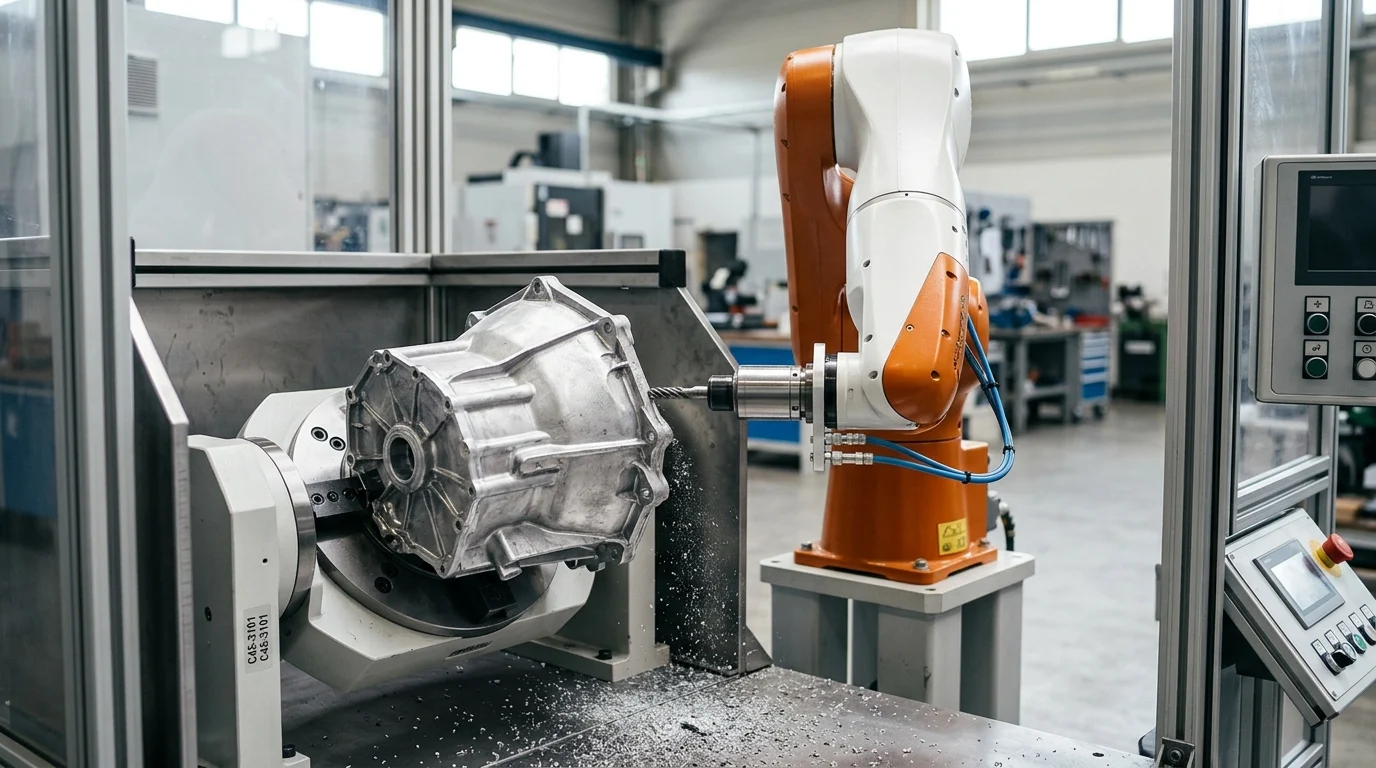
Manual deburring has become one of the most expensive weak points in many die-casting operations: it slows delivery, exposes workers to ergonomic risk, and leaves quality dependent on individual skill. As labor shortages intensify and customers demand cleaner, more repeatable parts, plants are turning to robotic deburring automation as a practical way to protect throughput and margins. This article explains where automation creates the most value, from managing flash variation across long production runs to reducing scrap, supporting ISO-driven requirements, and reshaping the skills needed on the shop floor.
Why Die-Casting Deburring Automation Matters
The die-casting industry faces a pivotal transition as manufacturers move away from manual finishing techniques toward advanced, robotic solutions. Historically, removing excess material from cast parts was a labor-intensive bottleneck that threatened overall plant efficiency. Today, die-casting deburring automation is no longer viewed as a luxury but as a critical infrastructure requirement for foundries aiming to remain competitive in global supply chains.
By integrating sophisticated robotic cells, manufacturers can stabilize their output, ensure strict dimensional accuracy, and protect their workforce from the ergonomic hazards associated with continuous grinding and filing.
Labor Shortages and Delivery Pressure
Labor markets for heavy industrial manufacturing are tightening globally. Data and economic reports from institutions like the World Bank highlight a continuous shift in industrial labor participation, making it increasingly difficult to staff repetitive, physically demanding roles. In many die-casting plants, manual finishing departments experience annual turnover rates frequently reported to exceed 35%.
While automation reduces the need for manual grinding labor, it simultaneously creates a demand for skilled integrators, programmers, and maintenance technicians—roles that are also scarce in heavy industry. However, for the core production line, automation eliminates the dependency on manual finishing, providing a predictable throughput. This allows production managers to commit to tight Just-In-Time (JIT) delivery windows without the constant threat of labor-induced bottlenecks.
Burr Variation, Flash Removal, and Repeatability
The die-casting process is inherently dynamic. Over a standard production run of 10,000 to 50,000 shots, thermal fatigue and mechanical wear on the tool inevitably lead to dimensional variations at the parting line. Consequently, flash thickness can fluctuate significantly, often ranging from 0.1mm on a new die to over 1.2mm as the die approaches the end of its lifecycle.
Manual operators struggle to adapt consistently to these variations, often over-grinding or under-grinding the part. Automated deburring systems equipped with active compliance technology solve this by maintaining a constant force against the part geometry. This ensures that flash is removed cleanly and repeatably, regardless of minor variations in the burr's thickness or the tool's wear state.
Quality, Cost, and Customer Requirements
Adhering to strict international standards requires highly reliable manufacturing processes. Many automotive, aerospace, and medical clients demand strict compliance with ISO standards for technical cleanliness and geometric tolerancing. A single burr detaching inside a transmission fluid channel can cause catastrophic system failure.
Automation directly addresses these quality mandates while simultaneously driving down costs. By replacing manual variability with robotic precision, plants routinely see finishing-related scrap rates drop significantly, with industry benchmarks frequently showing reductions from a baseline of 4% to less than 0.5%. Furthermore, the reduction in over-machined parts and the elimination of human error ensure that every component shipped meets exact customer specifications.
What Deburring Automation Includes
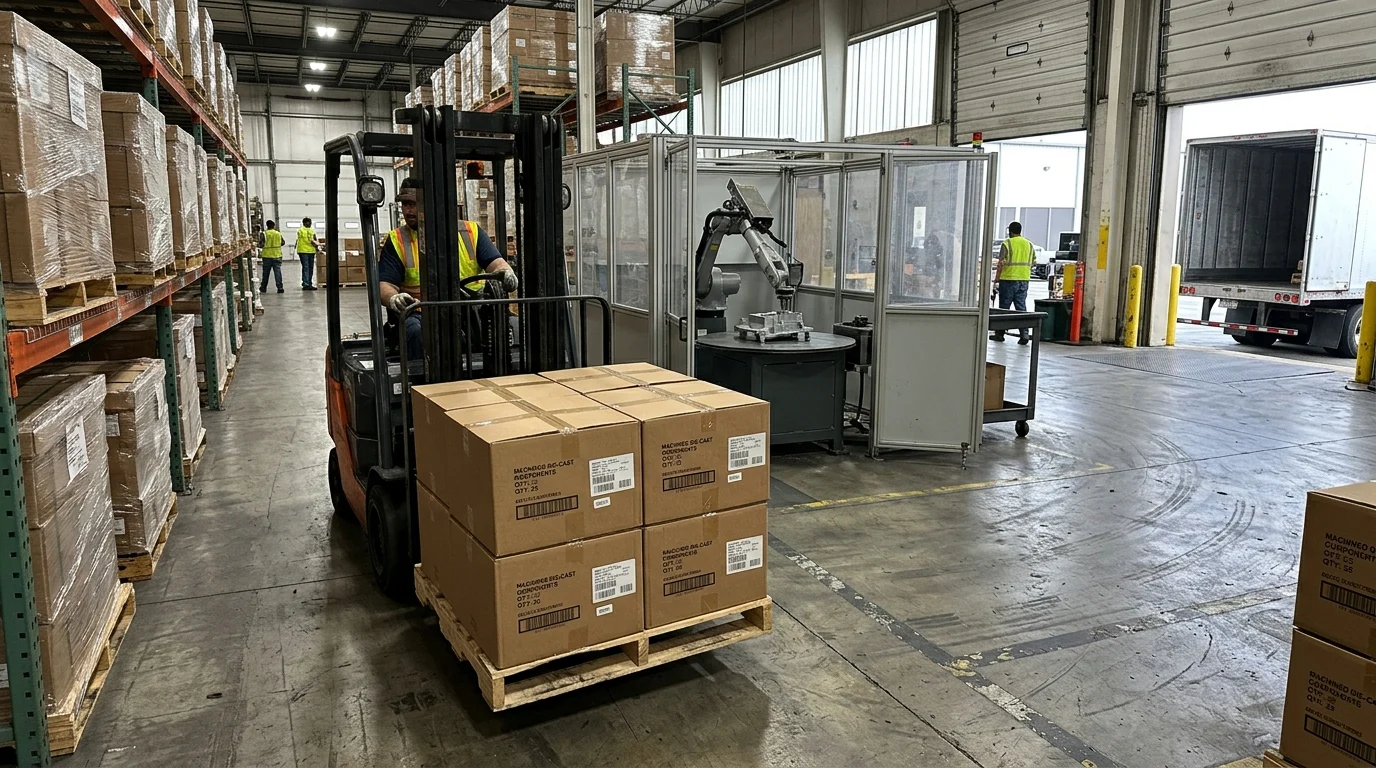
Modern die-casting deburring automation represents a comprehensive ecosystem of machinery, software, and tooling working in unison. It is not merely a substitute for a hand grinder, but a fully engineered cell designed to handle the complex geometries and tough alloys characteristic of the die-casting industry.
Definition and Scope
The scope of an automated deburring cell extends far beyond a simple robotic arm. A standard installation encompasses 6-axis industrial robots, specialized force-compliant spindles, automated tool changers, and robust part-presentation fixtures. Advanced setups also integrate machine vision systems to identify part orientation and dynamically adjust toolpaths.
This holistic definition means that the automation system is responsible not just for material removal, but for adapting to the physical realities of the casting environment, managing its own tool wear, and ensuring that the finished edge profile falls within strict engineering tolerances.
Process Flow from Casting Discharge to Inspection
A typical automated flow begins the moment the casting is ejected from the die-casting machine (DCM). After a critical cooling phase to ensure dimensional stability, the part is usually transferred to a hydraulic trim press for bulk flash removal. Once trimmed, the part enters the robotic deburring cell.
Cycle times for the deburring phase are meticulously engineered to match the pacing of the DCM, typically ranging from 45 to 90 seconds per part. Inside the cell, the robot maneuvers the part against stationary abrasive tools, or manipulates a spindle around a rigidly fixtured part, concluding with an automated blow-off sequence before the casting is discharged for final inspection.
Burr Types, Part Geometry, and Alloy Considerations
The physical characteristics of the burr and the base material heavily dictate the configuration of the automation cell. Aluminum, zinc, and magnesium alloys behave differently under abrasive contact, requiring specific tooling geometries and spindle speeds to prevent material smearing or excessive heat generation.
| Alloy Type | Typical Flash Thickness | Machinability | Recommended Tooling |
|---|---|---|---|
| Aluminum (A380) | 0.2mm - 1.5mm | Moderate | Carbide rotary files, aggressive brushes |
| Zinc (Zamak) | 0.1mm - 0.8mm | High | High-speed steel (HSS), fine abrasives |
| Magnesium (AZ91D) | 0.1mm - 1.0mm | Very High | Specialized geometry cutters (fire risk) |
Part geometry also plays a crucial role. Deep cavities or intersecting cross-holes require extended-reach tooling and precise articulated movements to clear internal burrs without damaging the primary sealing surfaces of the casting. In some scenarios, highly complex internal geometries may still prove unsuitable for standard robotic deburring, requiring specialized electrochemical processes or remaining a manual task.
Deburring Methods and Automation Options
Selecting the appropriate mechanical removal method is critical to the success of the automated cell. The choice between different robotics configurations and abrasive tools determines not only the initial capital cost but also the long-term flexibility and operating expenses of the system.
Manual, Semi-Automatic, and Robotic Deburring
Foundries must choose between varying levels of automation. Semi-automatic systems often involve operators loading parts into automated CNC fixtures, which is suitable for mid-volume production. In contrast, fully robotic deburring relies on industrial arms that handle the entire sequence without human intervention.
However, for low-volume, high-mix production environments, the programming and fixturing overhead of full automation may not be justifiable, making semi-automatic or manual methods more practical. When full automation is deployed, systems generally utilize one of two configurations: tool-to-part or part-to-tool. For heavy structural castings like automotive engine blocks, tool-to-part is preferred, requiring robots with payload capacities of 30kg to 60kg to manipulate heavy spindles. Conversely, lighter components are often gripped by the robot and manipulated against stationary grinding belts and brushes.
Brushing, Milling, Grinding, Filing, and Cutting
Different edge features require specific mechanical actions. High-speed spindles operating at 20,000 to 40,000 RPM are typically deployed with tungsten carbide rotary files to mill away heavy parting-line flash. This provides a clean, chamfered edge but can leave minor machining marks.
To achieve a smooth, blended finish, automated cells follow up the milling process with brushing or grinding. Abrasive nylon brushes or wire wheels are highly effective at radius blending and removing micro-burrs from complex contours. Cutting and filing tools are reserved for specific, hard-to-reach internal geometries where traditional rotary tools cannot fit.
Cycle Time, Consistency, Tooling Cost, and Flexibility
Cycle time optimization relies on minimizing non-value-added movements. Automated tool changers (ATC) allow a single robot to swap end-effectors in under 4 seconds, enabling the cell to perform aggressive milling and fine brushing on the same part seamlessly.
While customized tooling ensures consistency, it introduces consumable costs. However, because robotic systems utilize active force control, abrasive tools wear much more evenly compared to manual operations. Facilities frequently report a 20% to 30% increase in tool life, which significantly offsets the initial investment in higher-grade automated consumables while maintaining maximum production flexibility.
How to Specify and Integrate a Deburring System
Transitioning from manual labor to automated finishing requires rigorous upfront engineering. A poorly specified system can lead to massive integration headaches, excessive downtime, and an inability to meet the required quality standards. Careful planning must encompass everything from part presentation to final safety sign-offs.
Part Families and Edge Quality Requirements
The first step in specification is grouping parts into families based on size, weight, and geometric similarity. This allows engineers to design modular grippers and standardized fixturing that can accommodate multiple part numbers with minimal changeover time.
Equally important is the mathematical definition of edge quality. Vague requirements like 'remove all sharp edges' must be translated into quantifiable engineering tolerances, such as a maximum edge break of 0.5mm or a specific surface roughness (Ra) value. These objective criteria form the basis for programming the robot's toolpaths and feed rates.
Trials, Robot Reach, Fixturing, and Tool Access
Prior to hardware installation, integrators utilize 3D simulation software to verify kinematics. The robot must have adequate reach—typically requiring a working envelope of 1.5 to 2.5 meters—to access all necessary features without colliding with fixtures or safety fencing.
Physical trials are then conducted to validate tool access and force parameters. Active compliance devices are tuned during this phase to maintain a constant contact force, generally between 15 and 50 Newtons, ensuring that the tool follows the casting's actual contour rather than a rigid, theoretical path.
Integration with Trimming, Washing, Inspection, and Safety
An automated deburring cell cannot operate in isolation; it must communicate seamlessly with upstream and downstream equipment. Programmable Logic Controllers (PLCs) handle the handshakes between the trim press, the deburring robot, and downstream ultrasonic washing stations.
| Process Step | Equipment Required | Key Data Exchanged | Primary Automation Goal |
|---|---|---|---|
| Trimming | Hydraulic Trim Press | Part presence, cycle start/stop | Bulk flash removal |
| Deburring | 6-Axis Robot & Spindle | Tool wear status, force feedback | Precision edge blending |
| Washing | Ultrasonic Bath | Batch readiness, fluid temp | Removal of cutting debris |
| Inspection | Vision System | Pass/fail coordinates | Quality verification |
Safety integration is equally critical. Enclosures must not only protect workers from moving machinery but also manage the extraction of metallic dust. When processing combustible materials like magnesium, strict adherence to explosive dust mitigation standards (such as ATEX or NFPA) is mandatory. Automated magnesium deburring typically requires specialized explosion-proof dust collection systems, inert gas flooding, or dedicated cell designs to prevent catastrophic facility fires.
How to Build the Business Case
Deploying robotic deburring represents a significant capital expenditure. To secure executive approval, plant managers and manufacturing engineers must construct a comprehensive business case that captures both the direct financial savings and the strategic operational benefits.
Labor, Scrap, Rework, Tooling, and Downtime Costs
The financial model typically begins with direct labor savings—eliminating the wages, benefits, and overtime associated with a multi-shift manual grinding department. However, the most substantial savings often emerge from scrap and rework reduction. By drastically reducing scrap rates, foundries save not only the processing time but also the energy and raw material costs associated with remelting defective parts.
Additionally, automated systems stabilize tooling costs. The controlled application of force prevents the premature tool breakage common in manual operations. Furthermore, the reduction in ergonomic injuries translates to lower workers' compensation premiums and decreased costs associated with employee downtime and retraining.
Payback, Technical Risk, and Decision Criteria
Decision criteria heavily weigh the return on investment (ROI). A well-designed automated deburring cell typically requires an estimated initial capital expenditure ranging from $150,000 to $400,000, depending on the payload capacity, sensor complexity, and required tooling.
Despite this upfront cost, high-volume die-casting operations frequently report achieving full payback within 18 to 24 months. When evaluating the technical risk, management must also consider the cost of inaction: failing to automate can result in lost contracts if competitors can guarantee higher cleanliness standards and tighter delivery schedules.
Pilot Projects and Phased Rollout
To mitigate integration risks, experienced foundries avoid attempting to automate their entire product catalog simultaneously. Instead, they utilize a phased rollout, beginning with a pilot project focused on a single, high-volume, long-running automotive or industrial component.
Once the pilot cell proves its reliability and the maintenance team becomes comfortable with the robotic programming and tool management, the plant can scale the technology.
Key Takeaways
- Evaluate deburring automation when manual finishing turnover, often above 35% in heavy industrial roles, threatens delivery reliability.
- Use robotic cells with active compliance to control flash variation that may grow from about 0.1 mm to over 1.2 mm during die life.
- Target high-repeatability production runs of 10,000 to 50,000 shots where automated deburring can stabilize output and reduce operator variability.
- Quantify ROI by tracking finishing scrap, since automated processes can reduce benchmark scrap levels from about 4% to below 0.5%.
- Plan for new technical roles because automation shifts labor demand from manual grinding to robot programming, maintenance, and process optimization.
Frequently Asked Questions
Why are die-casting plants automating deburring?
Plants automate deburring to reduce manual finishing bottlenecks, stabilize throughput, improve part consistency, and protect workers from repetitive grinding and filing tasks.
How does robotic deburring handle flash variation?
Robotic systems with active compliance maintain consistent contact force, helping remove flash even as burr thickness changes from die wear or thermal variation.
What quality improvements can automation deliver?
Automation reduces operator variability, supports tighter dimensional control, and can help lower finishing-related scrap from around 4% to below 0.5% in benchmark cases.
Is deburring automation only for high-volume plants?
No. It is most valuable in repeatable production, but flexible robotic cells can also support mixed parts when tooling, fixtures, and programming are properly planned.
What skills are needed after installing deburring robots?
Plants need fewer manual grinders but more technicians who can program, maintain, troubleshoot, and optimize robotic grinding and deburring systems.