


As EV production scales, the definition of a “finished” component is changing. Parts that once only needed acceptable fit now must meet tighter acoustic, thermal, and geometric requirements because there is no combustion engine to hide vibration or drivetrain noise. Precision grinding has become a core EV manufacturing process, shaping battery housings, rotor and stator surfaces, reduction gears, and bearing interfaces to support efficiency, durability, and quiet operation. This article explains why grinding matters in electric powertrains, which components demand the highest accuracy, and how manufacturers can align surface finish, tolerance control, and repeatability with the performance expectations of the EV era.
Why EV Component Grinding Matters
The transition from internal combustion engine (ICE) vehicles to electric vehicles (EVs) has fundamentally altered manufacturing tolerances across the automotive supply chain. Without a combustion engine to mask mechanical noise, structural and acoustic requirements for vehicle components have become stricter. Electric vehicle component grinding is no longer just a finishing step; it is a critical manufacturing process required to achieve the exact geometries necessary for modern electric powertrains.
Precision grinding addresses the unique mechanical stresses inherent to EVs, such as high-frequency vibrations. As global automotive markets pivot toward electrification, mastering these advanced material removal processes is essential for meeting regulatory standards and consumer expectations.
Performance and Reliability Benefits
Because electric motors operate quietly, minor gear whines or bearing vibrations become prominent. Precision grinding ensures that gear teeth and mating surfaces mesh perfectly, which helps keep cabin noise levels below industry targets—often aiming for 65 decibels (dB) or lower, depending on the vehicle class and acoustic design.
Beyond acoustics, superior surface finishes directly impact vehicle range. High-precision grinding reduces mechanical friction within the drivetrain. By optimizing the surface topography of transmission gears and bearings, manufacturers achieve drivetrain efficiency improvements; friction reduction directly extends driving range per charge.
Commercial Pressures Driving Precision Grinding
Tier 1 suppliers and original equipment manufacturers (OEMs) face immense pressure to minimize waste, targeting rigid scrap rate thresholds, such as 1.5% or lower. Any deviation in component geometry can lead to motor failure or assembly line downtime, incurring significant financial costs.
Furthermore, adherence to international quality management frameworks, such as ISO standards for surface texture and quality management (including ISO 1302 and IATF 16949), requires verifiable, repeatable precision. The commercial viability of an EV program relies on standardizing these grinding processes to yield consistent tolerances, ensuring components perform reliably over a typical 10- to 15-year vehicle lifespan.
EV Components That Require Grinding
While an electric vehicle has fewer moving parts than a traditional gas-powered car, the components that remain are subjected to extreme operational demands. This shifts the focus of grinding operations from engine blocks and camshafts to specialized electrical and power transmission components. The entire architecture of the EV relies on the dimensional accuracy of these critical parts.
Battery, Motor, and Drivetrain Parts
The core of the EV powertrain consists of the battery housing, the electric motor, and the reduction gearbox. Battery housings require precision flat grinding to ensure a perfect seal and optimal distribution of thermal interface materials, with gap tolerances often restricted to less than 0.1 millimeters (mm). Any unevenness can lead to thermal hotspots and degrade battery life.
Inside the electric motor, the stator inner diameters and rotor outer diameters must be ground to near-perfect concentricity to maintain a consistent, ultra-narrow air gap. This gap directly dictates the magnetic flux efficiency of the motor. Meanwhile, drivetrain reduction gears must manage the instant, maximum torque delivered from zero RPM. Profile grinding these gears ensures the tooth flank geometry can withstand these high-torque loads without premature wear or failure.
Grinding Needs for Electric Motor Shafts
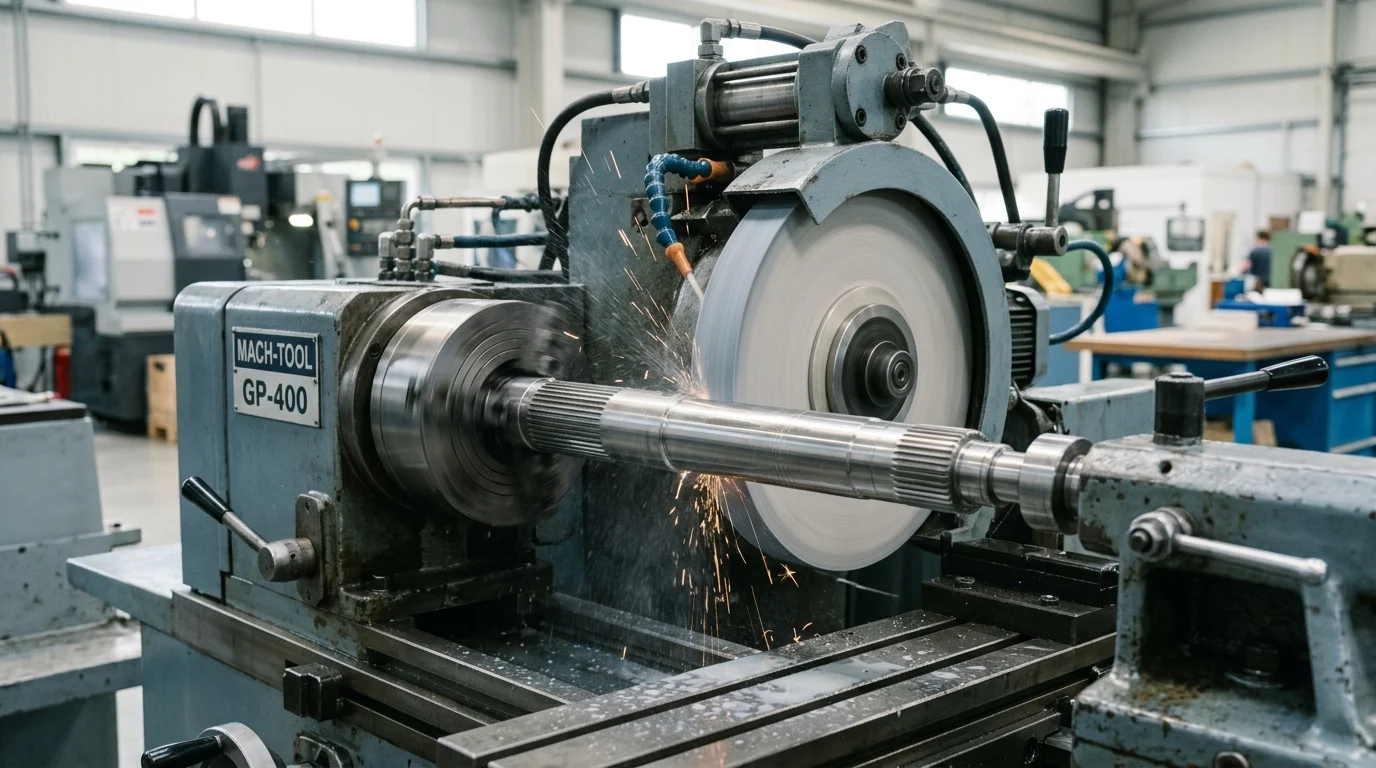
Electric motor shafts represent one of the most demanding applications for modern grinding technology. Because EV motor shafts routinely operate at 15,000 to 25,000 RPM, manufacturing requires specific techniques like thread grinding for rotor-shaft features and dynamic balancing as a mandatory post-grinding step. Engineers must also navigate the trade-offs between between-centers grinding, which offers superior concentricity for long shafts, and centerless grinding, which provides higher throughput for simpler geometries.
The bearing journals on these shafts require a mirror-like surface finish to minimize friction and heat generation, demanding multi-stage grinding operations that combine roughing, semi-finishing, and ultra-fine polishing in rapid succession.
Material and Tolerance Requirements
The shift to electrification has introduced a new matrix of materials and tightened the acceptable margins for error. Grinding operations must now adapt to lightweight alloys, highly conductive metals, and advanced ceramics, all while holding tolerances that are significantly stricter than those in legacy automotive manufacturing.
Key Tolerance Comparison Factors
Comparing the dimensional requirements of ICE and EV components highlights the technological leap required in modern grinding facilities. Runout, surface roughness, and rotational balance specifications have all crossed into the sub-micrometre (µm) territory. Note that these specifications vary significantly by OEM and vehicle segment; the following table presents illustrative industry ranges rather than universal standards.
| Metric | Typical ICE Specification | Typical EV Specification |
|---|---|---|
| Motor/Engine Shaft RPM | 6,000 - 8,000 RPM | 15,000 - 25,000 RPM |
| Shaft Concentricity / Runout | 10 - 15 µm | < 5 µm |
| Gear Surface Finish (Ra) | 0.4 - 0.8 µm | 0.1 - 0.3 µm |
| Gear Mesh Noise Target | Less critical (masked by combustion) | Typically < 65 dB |
This table illustrates the necessity for advanced grinding machinery. Achieving an Ra surface finish of 0.1 µm on a gear tooth requires highly rigid machine beds, active temperature compensation, and specialized abrasive technologies that were previously reserved for aerospace applications.
Grinding Aluminum, Copper, Steel, Ceramics, and Coatings
EVs rely on a diverse material mix to balance weight, conductivity, and durability, but processing these materials introduces risks of specific manufacturing defects. Aluminum is heavily used for structural lightweighting; however, grinding aluminum risks wheel loading, where soft metal chips clog the abrasive wheel. This requires highly porous grinding wheels and high-pressure coolant systems with specialized lubricity. Furthermore, grinding is not always the optimal process for thin-walled aluminum housings due to the risk of distortion from clamping-induced stress.
Copper, essential for specialized electrical contacts and busbars, presents similar challenges due to its ductility and tendency to smear rather than cut. For soft copper, alternative processes like electrical discharge machining (EDM) or precision milling are sometimes preferable. When grinding is necessary, it requires precise wheel selection and targeted coolant application. High-strength steel alloys used in shafts and gears require immense cutting forces, often necessitating vitrified super-abrasives to prevent thermal damage (grinding burn) or metallurgical alterations.
Advanced EVs also utilize ceramics, such as silicon nitride for motor bearings, to prevent electrical arcing. Grinding these ceramics demands diamond abrasives and highly stable machine kinematics to achieve surface finishes that can reach as fine as 0.05 µm (Ra) without inducing micro-cracks. Finally, specialized protective coatings applied to stators and rotors must be precision-ground to exact thicknesses to maintain electrical insulation and thermal conductivity. Across all these materials, the coolant management, disposal, and high energy consumption of high-speed grinding are growing compliance and cost concerns that facilities must actively manage.
Process Steps for Better Grinding Quality
Consistently achieving the tight tolerances required for EV components demands a heavily optimized, multi-stage grinding process. Manufacturers must carefully orchestrate abrasive selection, rigorous metrology, and real-time process adjustments to scale production without sacrificing quality.
Selecting Wheels and Abrasives
The choice of grinding wheel is the most critical variable in the material removal process. For hardened steel EV gears and shafts, vitrified cubic boron nitride (cBN) wheels are the industry standard. cBN abrasives maintain their sharp cutting edges at high temperatures, allowing for peripheral wheel speeds typically ranging from 90 to 120 meters per second (m/s).
These high speeds facilitate rapid material removal rates while keeping the cutting zone cool, which is vital to prevent thermal damage to the workpiece. For ceramic components and carbide tooling, diamond wheels are deployed. Selecting the correct bond type—whether vitrified, resin, or metal—determines how effectively the wheel self-sharpens and manages heat during continuous high-volume production. Maintaining these wheels requires precise dressing and truing intervals to ensure consistent profile accuracy and prevent glazing.
Inspecting Roundness, Flatness, and Surface Finish
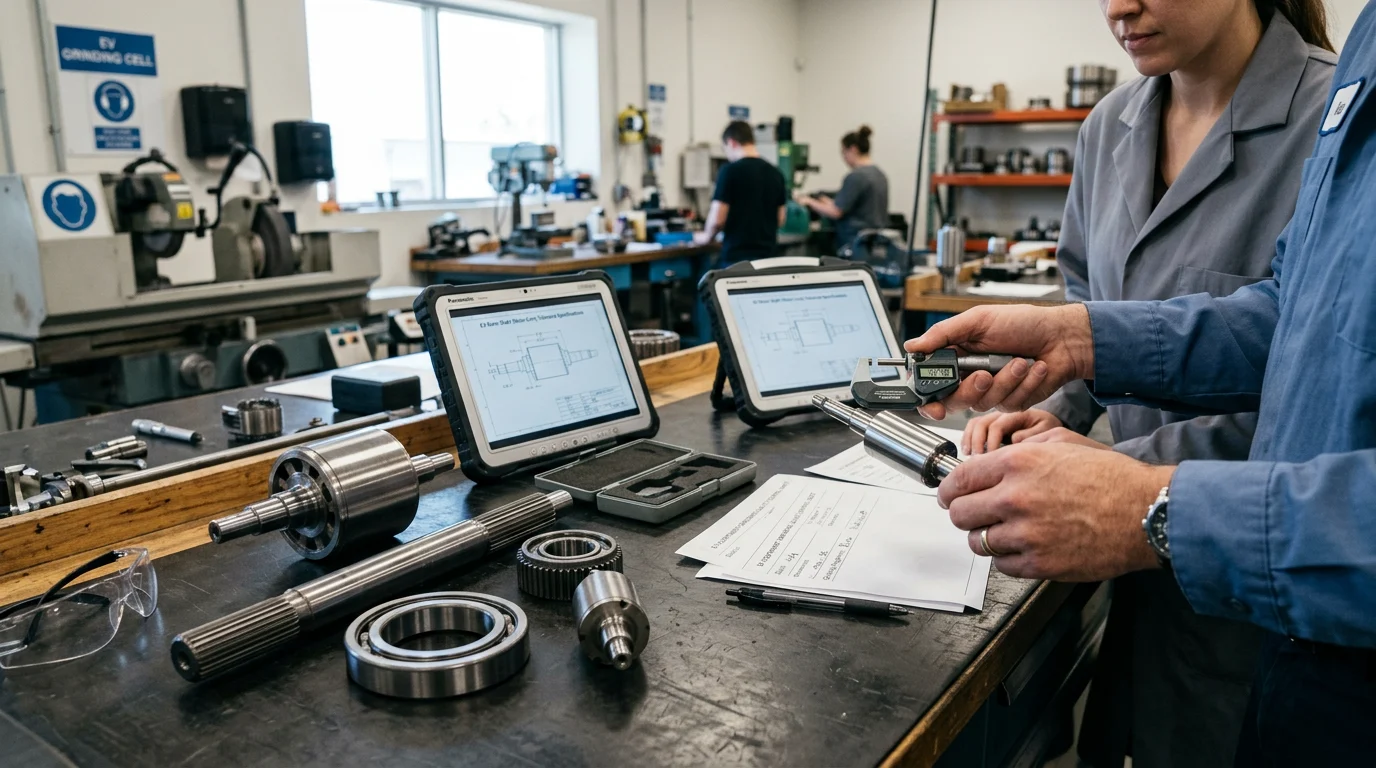
Quality control in EV component grinding relies on meticulous inspection of roundness, flatness, and surface finish. Roundness is particularly vital for motor shafts; deviations greater than 0.5 µm can lead to unacceptable vibration at high speeds. Flatness is equally critical for battery cooling plates to ensure maximum contact area for thermal dissipation.
Surface finish is typically quantified using Roughness Average (Ra) and Mean Roughness Depth (Rz). To verify these metrics and detect common defects like thermal damage or residual stress, facilities employ a combination of tactile probing and non-contact optical metrology. Optical systems are increasingly preferred for complex gear geometries, as they can scan thousands of data points in seconds to generate a comprehensive 3D topographical map of the ground surface.
Using Automation and In-Process Gauging
To meet the dual demands of high throughput and zero-defect quality, automation and in-process gauging are indispensable. In-process gauging utilizes tactile sensors that measure the workpiece while it is actively being ground. If the gauge detects the part approaching its upper tolerance limit, it feeds this data back to the CNC controller to adjust the wheel feed rate in real time, compensating for wheel wear and thermal expansion.
Coupled with robotic loading and unloading systems, automation ensures consistent part handling and eliminates human error. A fully automated EV shaft grinding cell reduces cycle times and boosts overall equipment effectiveness (OEE) while maintaining strict adherence to dimensional targets.
EV Component Grinding Decision Framework
Establishing a reliable supply of precision-ground EV components requires strategic decision-making by manufacturing engineers and procurement teams. Stakeholders must weigh the financial, logistical, and quality control implications of their grinding operations to remain competitive in a rapidly evolving market.
In-House Versus Outsourced Grinding
The decision to keep grinding operations in-house or to outsource them hinges on production volume, risk tolerance, and capital expenditure (CapEx). High-precision CNC grinding machines require significant investment, alongside necessary metrology equipment and climate-controlled infrastructure.
For lower-volume production, outsourcing to specialized grinding shops is a cost-effective route to avoid heavy CapEx. Conversely, for high-volume EV platforms, bringing grinding in-house provides greater control over production schedules and intellectual property. In-house adoption carries risks beyond initial costs, including the need to hire specialized machinists and manage complex maintenance overhead.
Cost, Compliance, and Logistics Factors
Beyond equipment costs, regulatory compliance and logistics play a major role in the sourcing strategy. Automotive suppliers must adhere strictly to IATF 16949 quality management standards, requiring rigorous documentation and traceability for every ground component. Managing these compliance requirements across a fragmented, outsourced supply chain can introduce significant overhead.
Logistics and supply chain resilience are also critical. Reports on global trade and supply chain resilience highlight that localized supply chains are generally more resilient to logistical shocks. Shipping heavy, precision-machined EV components across long distances incurs high freight costs and risks transit damage (such as micro-corrosion or physical impacts) that can ruin a perfectly ground surface. Furthermore, scrap costs on high-value EV alloys can inflate overall part costs if quality control loops are delayed by geographical distance.
Final Buyer and Manufacturer Checklist
To finalize the sourcing strategy, procurement teams and manufacturing engineers must utilize a structured evaluation process. The following matrix summarizes the core trade-offs between in-house and outsourced grinding models. Note that the figures provided are illustrative thresholds that vary significantly by machine size, region, and specific OEM requirements.
| Decision Factor | In-House Grinding | Outsourced Grinding |
|---|---|---|
| Capital Expenditure (CapEx) | High (often >$500k per machine) | Low (absorbed in piece price) |
| Volume Threshold | > 50,000 units/year | < 50,000 units/year |
| Quality Control | Direct oversight | Dependent on supplier audits |
| Lead Time Flexibility | High | Moderate to Low |
Ultimately, the final buyer checklist must include strict capability audits. Whether manufacturing internally or vetting a supplier, buyers should demand a Machine Capability Index (Cmk) greater than 1.67 and a Process Capability (Cpk) greater than 1.33 as standard baseline targets, though these will scale based on the specific application and region. To move forward, teams should first audit their projected annual volumes against these CapEx thresholds, assess their internal metrology capabilities, and map out potential supply-chain logistical risks.
Key Takeaways
- Use precision grinding to control EV drivetrain noise, because quiet electric motors make minor gear whine and bearing vibration more noticeable.
- Target smooth, repeatable surface finishes on gears and bearings to reduce friction and help improve drivetrain efficiency and driving range.
- Maintain battery housing flatness and sealing surfaces within tight limits, often below 0.1 mm, to support thermal management and battery durability.
- Grind stator inner diameters and rotor outer diameters for high concentricity to preserve the narrow air gap that drives motor efficiency.
- Standardize grinding processes around measurable tolerances and quality frameworks such as ISO 1302 and IATF 16949 to reduce scrap and support long-term reliability.
- Design EV grinding operations to meet commercial scrap targets near 1.5% or lower, since geometry deviations can cause costly failures and downtime.
Frequently Asked Questions
Why is precision grinding more important for EV components than ICE components?
EVs run much quieter than combustion vehicles, so gear whine, bearing vibration, and surface defects are more noticeable. Precision grinding helps meet tighter geometry, acoustic, and efficiency requirements.
Which EV parts commonly require grinding?
Commonly ground EV parts include battery housing sealing surfaces, stator inner diameters, rotor outer diameters, reduction gears, bearings, and other drivetrain mating surfaces.
How does grinding affect EV range?
High-precision grinding improves surface finish and reduces friction in gears and bearings. Lower drivetrain friction helps convert more battery energy into motion, supporting better range per charge.
What tolerance matters for EV battery housings?
Battery housing surfaces often require very tight flatness and gap control, sometimes below 0.1 mm, to support sealing, thermal interface material distribution, and battery life.
How does grinding reduce EV noise?
Grinding produces more accurate gear teeth, bearing surfaces, and mating geometries. This improves meshing and reduces high-frequency vibration that can cause audible whine in quiet EV cabins.